LOSS OF ENERGY
ABOUT PROJECT
GOALS
WHAT IS THIS "LIGHT POLLUTION"?
REGISTRATION
COOPERATORS
ACTIVITIES
CONTRIBUTIONS
FUNNY
GALLERY
CONNECTONS
RESEARCH TASK
HOME SCHOOL
Loss of energy – incorrect use of streetlights
Incorrect lights and their incorrect use aren't
just disturbing for nature but are also highly uneconomical.
Today high-pressure mercury lights are mostly used but their utilisation rate is
falling quickly and they have a negative impact on the environment. Their energy
efficiency is very low. Standards in planning and manufacturing
streetlights should be raised to reduce energy consumption with the use of full
cut-off lamps. In this way we would reduce glare and save energy.
For
example:
1. Zebra crossings should be lit, but not the surrounding areas.
2. We should use more efficient lights and regulate electronic waste.
Road lamps
There are three ranges of light emission: only the range 3 is useful.
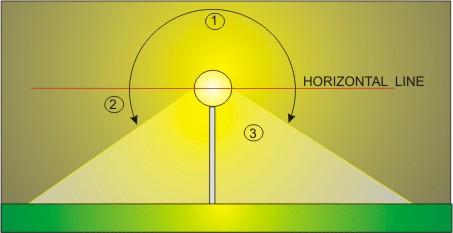
1st range: the light which passes over the horizontal line (red) is the lost energy. This light disturbs astronomers, insects and birds (migrators).
2nd range: the light which is pointed downwards. Its lowest point to the horizontal line is at the angle of 30%. The floor-lighting effect is poor; moreover it creates long shadows. It has a strong negative impact because it disturbs eye adaption to weak light. It causes glare.
Glare is particularly unpleasant for older people because the light diffusion in their eye creates a " curtain " which disturbs vision. Such streetlighting reduces safety.
Lights 1 in 2 are not only visible from very far and attract insects from a wide area, they also represent a waste of energy. Dead insects are usually glued to them. The layer of dead insects reduces their light performance and demands additional regular cleaning. This situation is so bad because of the use of only partly cutoff lamps.
Some designers and constructors try to avoid this glaring problem by dimming light bulbs with milk glass or plastic. But because of the strong contrast between light and dark environment such lamps are still bad. Moreover, these lights have very bad utilisation rate.
There are other problems with this solution: such light is diffused in all directions /also over the horizontal line/. The loss of light preformance energy is around 30% with new and over 50% with old lights. Such bulbs are stained very quickly and the loss of energy is even higher. The final utilisation rate is low.
Open outdoor lamps are the worst for the environment. They are dirty and cause that insects touch them, burn and die.
The only suitable and harmless are full cutoff lamps, which do not emit light above the horizontal line.
Translation or lecturetion: Janja Anzicek

Influenc
on astronomy
Influenc on
animals
We keep planet