Velika meteorska nevihta leta 1966
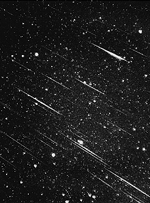
Po 65 letih mirovanja so leta 1966 Leonidi nad severno Ameriko izbruhnili v
največjo meteorsko nevihto v zabeleženi zgodovini. Opazovalci iz zahodnih ZDA
so poročali o kar 150 000 Leonidih na uro, oz. 40-50 Leonidih na sekundo. Ta
spektakel pa je videlo zelo malo ljudi. Leonidi so namreč razočarali v letih
1899 in 1932, ko so pričakovali meteorski dež, tako da je bilo leta 1966 zanimanje
za Leonide majhno. Prav tako tedaj ni bilo tako natančnih napovedi za meteorske
roje, kot jih imamo danes, tako da je opazovalce sam meteorski deč, še posebej
pa njegova izjemna moč povsem presenetil. Poleg tega so veliki deli Kalifornije,
Floride in Oregona, kjer je bilo največje število meteorskih opazovalcev, zjutraj
18. novembra 1966 pod meglo. Spodaj je zbranih nekaj poročil opazovalcev, ki
so kljub vsemu videli ta nebesni spektakel...
Norman McLeod III
Tallahassee, Florida
Late evening of 1966 Nov 16 I went downstairs in the dormitory at Florida State.
Someone then informed me that a group of students had gotten wind of a big meteor
shower coming and that they were already up on the sun deck observing. This
being around 11 PM, I knew they were much too early as the radiant was just
below the horizon in the ENE. So I went to the sun deck myself to witness the
eager group waiting for action. I told them it was too early and to wait until
after 2 AM. But I doubt if anyone lasted long enough to see anything ; it was
nap time for me until 2 o'clock. (Adding this in 1999 : location Tallahassee,
Florida, latitude 30N, longitude 84W.)
...my Leonid rate reached 3/minute, which was right about 4:30 AM EST, or 1:30
AM PST where Bob [Lunsford] was. My rate of 6/minute didn't start until 5 AM.
Magnitude-only recording began at 5:03 AM, then without times after 5:19 AM.
In the period 5:19 to 6:00 I recorded 361 meteors, finishing at about 30/minute
as dawn and fog combined to end the show. It was a very steady rain of meteors,
one each two seconds, with none simultaneous and no bunching seen. During that
40 minutes I saw two -5's and four -4's ; these acted like punctuation marks
within the display. The following evening the local newspaper had a short article
on the front page headlined "Meteor Shower Fizzles." It was the usual
confirmation that the public needs a much stronger or brighter event than an
astronomer in order to be impressed. The peak came after sunrise ; it just couldn't
be observed. It was too foggy for the next few hours to try for daylight Leonids,
plus I was pooped. I was just thankful the fog held off until dawn. Soon after
that I thought about how sad it would be for new people to get interested in
meteors during 1967. I was born in 1946 and began meteors in 1960, so I was
fortunate to have a few years experience in time for the 1966 Leonids.
Dennis Milon
Kitt Peak (Observatory), Arizona
From 1h30m am MST (Mountain Standard Time, UT-7h) to 2h30m we made meteor
counts and magnitude estimates. Still, the rate of about 33 Leonids per hour
gave no indication of the spectacle to come...
...Our second hour of observing began at 2h50m. The observing was getting more
exciting as the rate climbed and the number of bright meteors increased. At
the end of the hour, at 3h50m, 192 Leonids had been recorded by a single observer.
Up to 30 of these were of negative magnitudes.
It was getting impossible to write down magnitude estimates as the meteors came
faster and faster. We started making counts per minute. The count was about
30 per minute at 4h10m. The sky literally began to rain shooting stars. Everywhere
we turned we saw them.
By 4h30m there were several hundreds per minute. The fantastic rate of about
40 per second was reached at 4h54m. A 43 second exposure of the Big Dipper showed
43 Leonids. Looking directly at the radiant gave the effect of depth of the
Earth moving through space. Point meteors marked the radiant. The rate was over
1000 per minute for 40 minutes from 4h35m to 5h15m. The peak of perhaps 2400
per minute was centered at 4h55m. Some said it was like a dream, an amateur
astronomer's dream come true!
James W. Young,
Tabletop Mountain (Observatory), California
The 1966 Leonid Meteor Shower was observed ... on the morning of November 17
starting at 2:30 AM through heavy clouds. By 3:30 AM, the clouds had completely
cleared while the intensity of the shower continued to grow.
Around 4:45 AM the shower seemed to peak with the sky filled with meteor trails
everywhere! The estimated peak of 50/second lasted for about 10 minutes. During
the event, as observed by the five members present, we photographed over 1000
meteor trails, including a dozen fireballs, the brightest one being -12 magnitude!
A total of 22 fireballs were seen by the group. During the peak, everyone felt
like we needed hard-hats, as the intensity was so great when we blinked our
eyes open (instead of closed), the sky was full of streaks everywhere!
Most of the lower areas in southern California were fogged in at the time, and
only a few reports from local truckers were reported along with ours in California.
Don Pearson,
Kitt Peak (Observatory), Arizona
Thirteen of us, mostly students, drove to observe and record the Leonids atop
Kitt Peak on the night of Nov. 16-17, 1966. We formed a circle of chairs and
began to study our assigned areas of the sky for meteors. It started off slowly,
about 30/hour. After 3 hours it picked up dramatically, and we observed a peak
of about 40/second that lasted for 10 to 20 minutes. This was 24,000 in a ten
minute period, a rate of 144,000/hour. We stood in awe as the sky seemed filled
with meteors. With this number of meteors falling simultaneously, and all from
the same radiant, the shortening of their paths near the radiant was quite obvious.
I was fortunate to have a 35 mm camera and tripod with me, and had several pictures
of the shower printed on the cover of Sky and Telescope shortly after. I doubt
I'll ever witness anything in the sky as spectacular as the Leonids of 1966.
Dave Seibert,
Pine Forrest, Mississippi
Several of the boys, the principal and I, stayed on the roof of the Sanitarium/Nursing
Home during the display. At it's height, three of us divided the sky into thirds,
faced different directions and counted for one hour. Our individual counts totalled
1,200 per hour.
Finally, well after daylight, I went to the cafeteria for breakfast, but paused
at the top of the hill to see just ONE more streaker. Sure enough, a large meteor
shot across the sky, leaving a BRIGHT GREEN trail for several seconds. That
was the outstanding thing about what we watched, that night: the glowing trails
that stayed behind after many of the fireballs extinguished.
Ed Cunnius,
north Texas
My mom woke me up that morning and told me to put on a coat and come outside.
I don't know the exact time. We normally had to get up at six o'clock, and it
was well before then--probably around five. I couldn't imagine what was going
on, but it had to be something pretty exciting if I could wear my pajamas outside.
As I ran out of the house, I remember my dad standing in the yard, quietly staring
at the sky. I could see the reason even before I was completely out the doorNthe
sky was covered with meteors, all seeming to rain straight down. My dad explained
that this was a "meteor shower" and that my grandfather had called
to wake us up so we could see it. Facing east, I looked up and into the "center"
of the storm where the meteors were so fast and constant it looked as if the
earth were rushing through the stars. As it began to get lighter and the sky
turned from black to dark blue; a gigantic fireball fell in the west leaving
a visible smoke trail. It was bright enough to overpower the predawn sky-glow,
turning the whole sky a pale blue-green. We watched until the sun came up. I
don't remember the rates tapering off much, just that the very faint meteors
became harder and harder to see. All morning faint, short-tailed meteors had
provided a kind of scratchy background to the brighter rain of material. From
that night on, anytime the weatherman announced a meteor shower was on the way,
I would fully expect another spectacle like the Leonids. I was jaded at the
age of six by the storm of the century.
Zemlja je leta 1966 prešla skoraj središčni del le 2 revoluciji starega vlakna iz leta 1899, kar je pomenilo, da je srecala zelo visoke prostorske koncentracije meteoroidov. ZHR je dosegel 150 000 meteorjev na uro. Takšna srečanja so izredno redka.