|
|
Tetris
In the work of Sašo Vrabič, the sinful use of extracts from the
media world intertwines with images and sounds from the private
world. The computer, which today we can no longer avoid, has greatly
marked the way of life, work and thinking of Vrabič's generation.
Tetris, perhaps the most famous and popular computer game, originated
in Russia. It was created by Alexei Payitnov, Dmitri Pavlovski and
Vadim Gerasimov of the Soviet Academy of Science in 1985. Tetris
could only enter in 'capital game' by sneaking through a hole in
the Iron Curtain and making its success on the Western market. But
the success of the game also exacted a price. Snatching at profits
led to clashes between the authors of the game, which was created
on the basis of love of computer programming. Meanwhile, it was
finding homes around the world. Therefore, Tetris is a game that
unites and divides. Its creation and market success are an ideal
example of the stereotype about the idealistic East being used,
distributed, and profited from, by the Western capitalist market.
Nowadays, Tetris is still played by everybody, no matter whether
they come from the East or the West. The left and right sides of
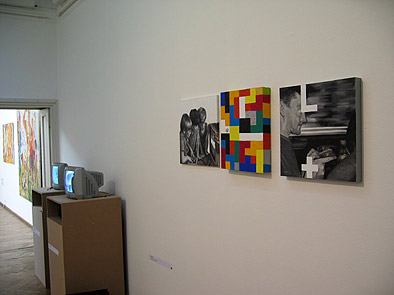
the triptych point at the universal character of the game, which
induces the same pleasure in all parts of the world that are steeped
in technology. Tetris is a game that can be enjoyed in a group,
but on the other hand, it also causes alienation and retreat into
another world. The computer game occupies the central coloured field
in Vrabič's triptych. The music starts when the viewer steps in
front of the triptych; it is similar to the melody accompanying
Tetris. This adaptation of a Russian folk song helps us move even
more easily into the Tetris world, and it makes us think: 'Do we
still control the computer and technology, or did they devour us
and now control us instead?'
Petja
Grafenauer
Sašo Vrabič is basically occupied with the image-generating mechanisms of our contemporary society; he recycles images from the mass media and places them into other contexts and relations. The Tetris Triptich is a traditional oil-canvas painting inspired by media images and an abstract close-up of the game itself. In the Triptich he cites playfully but also forebodingly the story of one of the world’s best known computer games whose birth has a strong link to the history of technology – to industrial theft during the cold-war period. Alenka Gregorič summarizes rather insightfully: “His focus is on re-interpreting the response of an individual towards life in contemporary society, which is saturated with new technologies.”
Edit Molnár
|
|
,-2004.jpg)
Tetris
(triptih), acrylic, oil on canvas, sound module, sensor, 2004,
50 x 50; 40 x 50 x 6cm; 50 x 50 x 5 cm.
|
|
