Chevrolet 
Chevrolet /ʃɛvrəˈleɪ/,
colloquially referred to as Chevy and formally the Chevrolet Division of General
Motors LLC, is a brand of vehicles produced by American automaker General Motors (GM). Louis Chevrolet and ousted General Motors founder William C. Durantstarted the company on
November 3, 1911 [2] as the Chevrolet Motor Car Company.
Durant used the Chevrolet Motor Car Company to acquire a controlling stake in
General Motors with a reverse merger occurring on May 2, 1918 and propelled
himself back to the GM presidency. After Durant's second ouster in 1919, Alfred Sloan, with his maxim "a car for
every purse and purpose," would pick the Chevrolet brand to become the
volume leader in the General Motors family, selling mainstream vehicles to
compete with Henry Ford'sModel T in
1919 and overtaking the Model T as the best-selling car in the United States by
1929.[3]
Chevrolet-branded vehicles are sold in most automotive markets
worldwide, with the notable exception of Oceania,
where GM is represented by their Australian subsidiary, Holden.
In 2005, Chevrolet was relaunched in Europe, primarily
selling vehicles built by GM Daewoo of
South Korea with the tagline "Daewoo has grown up enough to become
Chevrolet", a move rooted in General Motors' attempt to built a global
brand around Chevrolet. With the reintroduction of Chevrolet to Europe, GM
intends for Chevrolet to be a mainstream value brand, while GM's traditional
European standard-bearers, Opel of Germany,
and Vauxhall of England will be moved upmarket.[4] However,
GM reversed this move in late 2013, announcing that the brand would be
withdrawn from Europe, with the exception of the Camaro, and Corvette.[5] in 2016. After General Motors fully
acquired GM Daewoo in 2011 to create GM
Korea, the last usage of the Daewoo automotive brand was
discontinued in its native South Korea and succeeded by Chevrolet.
In North America, Chevrolet produces and sells a
wide range of vehicles, from subcompact automobiles
to medium-duty commercial trucks. Due to the prominence and name recognition of
Chevrolet as one of General Motors' global marques, Chevrolet, Chevy orChev is used at times as a synonym for
General Motors or its products, one example being the GM LS1 engine, commonly known by the name or a
variant thereof of its progenitor, the Chevrolet
small-block engine.
On November 3, 1911, Swiss race car driver and automotive
engineer Louis Chevrolet co-founded the Chevrolet Motor Company in Detroit with William C. Durant and investment partners William Little (maker of the Little automobile) and Dr.
Edwin R. Campbell (son-in-law of Durant) and in 1912 R. S. McLaughlin GEO of General Motors in Canada.
Durant was cast out from
the management of General Motors in 1910 for five years. He took over the Flint
Wagon Works, incorporating the Mason and Little companies. As head of Buick Motor Company prior to founding GM, Durant had hired Louis
Chevrolet to drive Buicks in promotional races.[6] Durant planned to use
Chevrolet's reputation as a racer as the foundation for his new automobile
company.
Actual design work for
the first Chevy, the costly Series C Classic Six,
was drawn up by Etienne Planche, following instructions from Louis. The first C
prototype was ready months before Chevrolet was actually incorporated. However
the first actual production wasn't until the 1913 model. So in essence there
were no 1911 or 1912 production models, only the 1 pre-production model was
made and fine tuned throughout the early part of 1912. Then in the fall of that
year the new 1913 model was introduced at the New York auto show.
Chevrolet first used the
"bowtie emblem"[7] logo in 1914 on the H
series models (Royal Mail and Baby Grand) and The L Series Model (Light Six).
It may have been designed from wallpaper Durant once saw in a French hotel
room.[8] More recent research by
historian Ken Kaufmann presents a case that the logo is based on a logo of the
"Coalettes" coal company.[9][10] Others claim that the
design was a stylized Swiss cross, in tribute to the homeland of Chevrolet's
parents.[11]
Louis Chevrolet had
differences with Durant over design and in 1915 sold Durant his share in the
company. By 1916, Chevrolet was profitable enough with successful sales of the
cheaper Series 490 to allow Durant to repurchase a controlling
interest in General Motors. After the deal was completed in 1917, Durant became
president of General Motors, and Chevrolet was merged into GM as a separate
division. In 1919, Chevrolet's factories were located at New York City;
Tarrytown, N.Y.; Flint, Michigan; Toledo, Ohio; St. Louis,
Missouri; Oakland, California; Fort Worth, Texas, and Oshawa, Ontario General Motors of Canada
Limited, McLaughlin's were given GM Corporation stock for the proprietorship of
their Company article Sept. 23, 1933 Finantial Post page 9.[12] In the 1918 model year,
Chevrolet introduced the Series D, a V8-powered model in
four-passenger roadster and five-passenger tourer models. Sales were poor and it was dropped in
1919.
Chevrolet continued into
the 1920s, 1930s, and 1940s competing with Ford, and after the Chrysler Corporation formed Plymouth in 1928, Plymouth, Ford, and Chevrolet were
known as the "Low-priced three".[13] In 1933 Chevrolet
launched the Standard Six,
which was advertised in the United States as the cheapest six-cylinder car on
sale.[14]
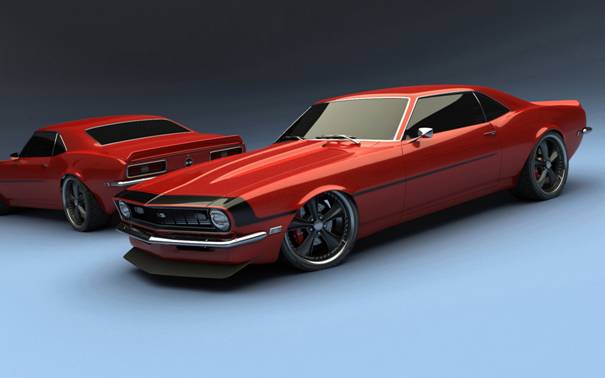
Chevrolet had a great
influence on the American automobile market during the 1950s and 1960s. In 1953
it produced the Corvette, a two-seater
sports car with a fibreglass body. In 1957 Chevy introduced its first
fuel-injected engine,[15] the Rochester Ramjet option on Corvette and passenger cars,
priced at $484.[16] In 1960 it introduced
the Corvair, with a rear-mounted air-cooled engine. In 1963 one
out of every ten cars sold in the United States was a Chevrolet.[17]
During the 1960s and
early 1970s, the standard Chevrolet, particularly the deluxe Impala series,
became one of America's best selling lines of automobiles in history.
The basic Chevrolet small-block
V8 design has remained in
continuous production since its debut in 1955, longer than any other
mass-produced engine in the world, although current versions share few if any
parts interchangeable with the original. Descendants of the basic small-block
OHV V8 design platform in production today have been much modified with
advances such as aluminium block and heads, electronic engine management, and
sequential port fuel injection. Depending on the vehicle type, Chevrolet V8s
are built in displacements from 4.3 to 9.4 litres with outputs ranging from 111
horsepower (83 kW) to 994 horsepower (741 kW) as installed at the
factory. The engine design has also been used over the years in GM products
built and sold under the Pontiac, Oldsmobile, Buick, Hummer, Opel (Germany), and Holden (Australia) nameplates.
In 2005, General Motors
re-launched the Chevrolet marque in Europe, using rebadged versions of the
Daewoo cars produced by GM Korea.[18]
The Chevrolet division
has largely recovered from the economic downturn of 2007–2010 through launching
new vehicles and improving existing lines. GM began developing more fuel
efficient cars and trucks to compete with foreign automakers. In late 2010
General Motors began production of the plug-in electric Chevrolet Volt (and related
Opel/Vauxhall Ampera), which later was announced as the 2012 North American Car
of the Year, European Car of the Year, and World Green Car of the Year.