(Stapelia_flavopurpurea1.zip)
Stapelia flavopurpurea MARLOTH
Marloth found this species in Southern Africa and described it in 1907 in the Transactions of the South African Philosophical Society. The name was chosen to reflect the yellow corolla and the purple or pink coloured hairs on it. For a limited time the variety name S. flavopurpurea var. fleckii was in circulation. However, it was sunk into synonymy with the parent species by Leach in his revision of the genus, due to the great variability of the corolla surface structure and colour and of the corolla cilia. The species is well known for its yellowish-green coloured petals, though dull-yellow, lime green, red and reddish-brown petals can also be found.
|
Stapelia flavopurpurea (Stapelia_flavopurpurea1.zip) |
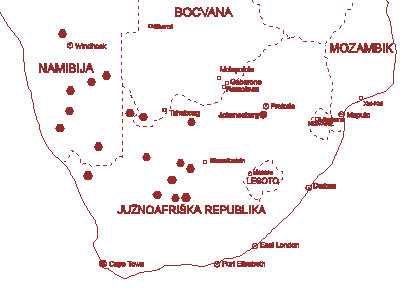
The yellow-purple stapelia is an exceptional species, for its flowers have a pleasant smell, in contrast with the other species of the genus. It is widespread in Southern Namibia, RSA (Namaqualand, W Karoo, Bushmanland, and W Griqualand).
|
|
|
Distribution map of S. flavopurpurea - marked
with |
It branches basally and grows in small clumps. The four-angled stems may attain a height of approx. 10 cm and are microscopically hirsute, appearing velvety. The stem diameter is approx. 1 cm. Young stems bear rudimentary sessile and caducous leaves.
|
|
|
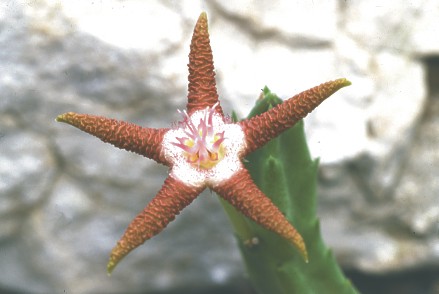
Stapelia flavopurpurea |
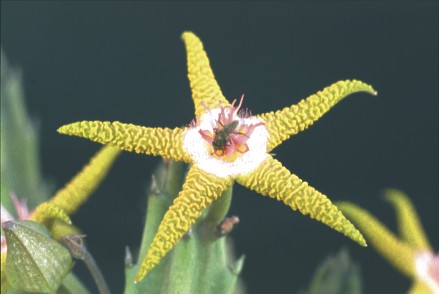
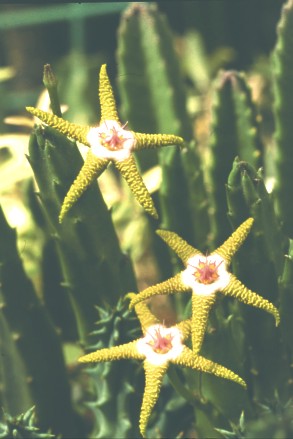
As a rule, the flowers are borne towards the stem apex and on young stems only. The inflorescences are many-flowered and the single buds with short pedicels (up to 3 cm) open successively. The upwards oriented flowers have barely noticeable sepals and a rotate corolla with approx. 3-4 cm in diameter. The lobes are triangular, deeply incised and narrow, with the length usually three times their width. The outer side is glabrous or minutely puberulous, while the inner side is deeply channelled in the traverse direction, the ridges being of a contrast colour, which is quite variable and may be anything from greenish-yellow to brown or red, sometimes even green. The flower center is funnelform, its border bearing up to 2 mm long, club-formed cilia. The colour may vary from white to dark purple. As mentioned at the beginning, the flowers are pleasantly odoured.
|
|
|
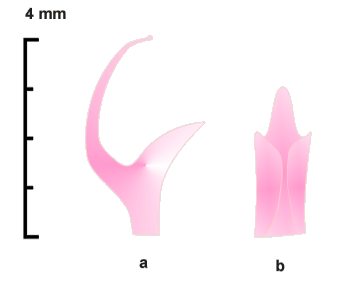
Inner corona
(a) Outer
corona (b) |
The corona is erect, and white or pinkish. The outer lobes point slightly upwards, are elongate, up to 3 mm long, with a dentate and pointed apex (Figure 1-b). The margins are folded inwards and form a tube which shelters the pollinaria, which are thus reached only with some difficulty. The inner corona lobes are dorsally flattened, erect and lean onto the staminal column (Figure 1-a). They are up to 6 mm long and almost filiform towards the apex. Laterally and close to the base, they are equipped with a horn-shaped dorsal wing. The pollinium is D-shaped and yellow or ochre coloured.
|
|
|
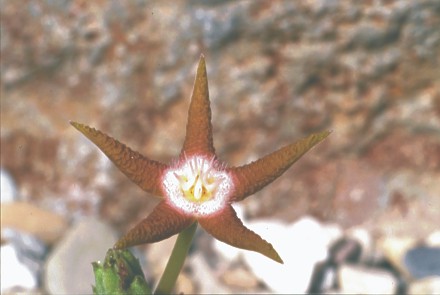
S. flavopurpurea, Farm Aar by
Aus, Namibia |
S. flavopurpurea is rarely found in collections, although it is not a demanding subject. It requires a free-draining substrate with a substantial proportion of coarse sand. The spreading shoots root easily, so that the clumps may be divided into separate plants. It flowers freely. During the period of active growth, it should be regularly watered and occasionally fertilised. The temperature during winter should be around 10-12 °C, while the plants should be kept almost dry. Care ought to be taken to avoid excessive dryness indicated by wrinkled stems, as such plants do not reestablish easily in the spring. Scale mites are its worst enemy while the black rot may take its toll especially in the autumn months.
|
|
|
Once, I found a small fly in a flower, captured in the
corpusculum with its proboscis. It was too weak to remove the pollinarium from
its position. |
Acknowledgment
I am very grateful to my friend Dr. Matija Strlic, who translated this article to English.
 |
Leach, L. C. (1985): Excelsa Taxonomic Series No. 3: A Revision of Stapelia; Aloe, Cactus and Succulent Society of Zimbabwe, Aloe Books, Johannesburg: 1-5, 76, 88-91 |
|
Hedgecock G. (1991): Early Botanical Explorations in South Africa; Asklepios 52: 79-83 |
|
Pilbeam J. (1992): Smaller-growing Stapelias; The Cactus File, vol. I, no. 7: 15-16 |
|
Mulej I. (1994): Cvetovi, ki ne dišijo 4.del: Predstavitev stapelijevk; Kaktusi in druge sočnice 3: 5-10 |
09-12-2000