MUNICIPALITIES IN SLOVENIA
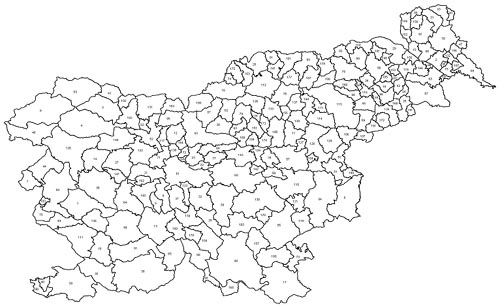
In Slovenia there are 193 municipalities, of which 11 are urban municipalities (Celje, Koper, Kranj, Ljubljana, Maribor, Murska Sobota, Nova Gorica, Novo mesto, Ptuj, Slovenj Gradec and Velenje).
The largest in number of inhabitants is the urban municipality of Ljubljana (276,313 inhabitants), and the smallest is the municipality of Hodoš with 371 inhabitants.
Breakdown of municipalities by number of inhabitants.
| Number of inhabitants | Number of municipalities | % |
| Under 5.000 | 95 | 49 |
| From 5.000 to 10.000 | 44 | 23 |
| From 10.000 to 50.000 | 51 | 26,5 |
| From 50.000 to 100.000 | 1 | 0,5 |
| Over 100.000 | 2 | 1 |
| Total | 193 | 100 |
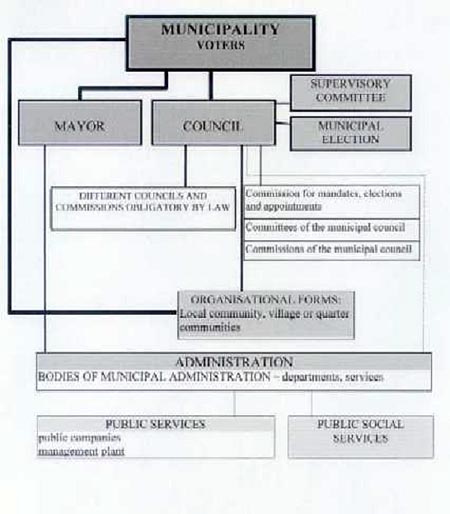
Pursuant to the Local Self-government Act, a Slovene municipality has three bodies: a municipal (town) council, a mayor and a supervisory committee. In the administration of the Municipality the crucial roles are played by the first two bodies, whereas the supervisory committee is the body controlling the public expenditures in the municipality.
Municipalies; Municipal boundaries; Source: Statistic bureau of Republic Slovenia, Geodetic Administration of Republic Slovenia
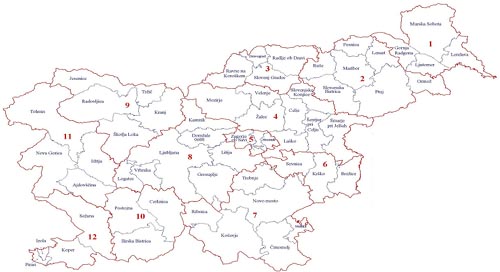
1. Pomurje region 2. Podravje region 3. Koroška region 4. Savinjska region 5. Zasavska region 6. Spodnjeposavska region 7. Region Jugovzhodna Slovenija 8. Osrednjeslovenska region 9. Gorenjska region 10. Notranjska region 11. Goriška region 12. Obalno-kraška region
Boundaries of the statistic regions and administration units
Source: Statistic bureau of Republic Slovenia, Geodetic Administration of Republic Slovenia, February 2001
MUNICIPAL COUNCIL AND MAYOR
At direct secret elections (proportional and majority system) inhabitants elect candidates to a representative body which, in Slovenia, is called a council. The council should be the body of a local self-government community which enables the influence of inhabitants of this community on decision-making. Via direct and secret elections pursuant to the criteria of modern democracy this influence is realized so that inhabitants may influence the issues as to who represents their interest in this body. Elections also exert a mobilization influence on inhabitants and produce an effect of an identification lever of inhabitants with the local community.
So elected representative body is the highest body of local self-government which adopts the most important acts and other decisions as well as performs the supervisory function. If we express it in a simplified way: the council performs the legislative function at the local level. The functions of local self-government resemble the functions of state administration. The principle of the division of authority to the legislative and executive branches can also be implemented at the local level. Both functions at the local administration level are performed by various local bodies. This also depends on the size of the local community. In local administration the most important decisions are made by a representative body elected by inhabitants, while the functions of local self-government are also performed by executive and administrative bodies.
Powers of the mayor (elected by majority voting system) may arise directly from the law or/and acts adopted by the local community's council. The way the mayor is appointed importantly influences his relation to the local community's council, since in case of a direct election at direct elections the mayor's position is substantially stronger and authority bigger. He/she also chairs the local community's council. System of local self-government has also at least one deputy mayors.
Let us in a few words define the role, powers and tasks which pursuant to the valid Local Self-government Act are performed by the municipal council and the mayor. In accordance with the law, the town council is the highest decision-making body deciding about all issues within the framework of rights and obligations of the municipality. Subjects of its jurisdiction are: adoption of the statutes, decrees and other municipal acts, spatial and other municipal development plans, the budget and final account; giving consent to the transfer of tasks from the state competence to the municipal one; appointing and recalling of the supervisory board members as well as members of commissions and committees of the municipal council; monitoring of the work of the mayor, deputy mayor and municipal administration regarding the implementation of decisions of the municipal council; giving opinions concerning the appointment of heads of administrative units; appointing and recalling of the municipality's representatives to the advisory committee of the head of the administrative unit; making decisions on the acquisition and alienation of the municipal property; appointing and recalling of members to the board for the protection of public goods' consumers; and making decisions on other issues stipulated by the law and statutes. It may also reach decisions on issues of state jurisdiction transposed to the municipality pursuant to the law, if not otherwise stipulated by the law so that decisions on these issues shall be reached by some other body.
The mayor represents the municipality and municipal council, convenes and chairs the council's meetings (but has no right to vote), proposes to the council the adoption of the municipality's budget and final account of the budget, decrees and other acts within the jurisdiction of the municipal council, and takes care of the implementation of decisions of the municipal council. The mayor also takes care of publishing the statutes, decrees and other general acts of the municipality. He/she may withhold the implementation of a certain decision of the municipal council if he/she estimates it to be unlawful or in contradiction with the statutes or other general act of the municipality.
ORGANS OF THE MUNICIPALITY
The organs of the municipality are: TOWN COUNCIL, MAYOR AND THE SUPERVISING COMMITTEE.THE TOWN COUNCIL
is the highest organ of decision-making in the municipality. It is concerned with the rights and duties of the municipality. It has 45 members.
The mayor represents the town council, he convenes and leads the town council meetings.
The vice-mayor can be authorized for the leading of the meeting. The Town Councile meetings are convened once a months.
WORKING BODIES OF THE TOWN COUNCIL
are committees and commissions of The Town Council. It has the following committees :
COMMISSIONS OF THE TOWN COUNCIL ARE:
THE SUPERVISING COMMITTEE
is the highest supervising organ of public consumption in the municipality. Its duties are:
DUTIES OF THE MUNICIPALITY
For the fulfilling the needs of its inhabitants it has following duties:
TOWN MUNICIPALITY ON ITS AREA MAINLY
THE TOWN MUNICIPALITY REGULATES THE FOLLOWING TAXES AND OTHER INCOMES:
DIRECT CO-OPERATION OF THE CITIZEN IN THE DECISION - MAKING
These forms are the Assembly of citizens, referendum and people's initiative.
CITIZENS ON THE ASSEMBLY OF THE CITIZENS:
REFERENDUM
The Town Council can call a referendum, where the citizens may accept or refuse the given document about municipality. The decision is accepted if the majority of the electors voted positively.
The initiative for the referendum may be given by every elector. At least 5% of the electors may demand the acceptance or annulment of the general document.
HOW DO YOU EVALUATE WORK OF YOUR LOCAL GOVERNMENT?
Work of the town council is evaluated every 4 years on the municipal elections, when the new members of the council and the mayor are elected. It is certainly evaluated during their work as well with the help of media.
In Slovenia the local government actually performs the duties which was it elected for. The duties are ordered by the system of the local self-government.
HOW DOES THE SCHOOL PREPARE YOUNG PEOPLE TO BE A CITIZEN, DO YOU TEACH THEM HOW TO USE THEIR CIVIL RIGHTS AND HOW TO FULFILL THEIR DUTIES?
The educational system in Slovenia is focused on the high national sense. In this context students become familiar with the children, national and civil rights. On the level of the local communes the educational work helps to build the appurtenance to the commune.