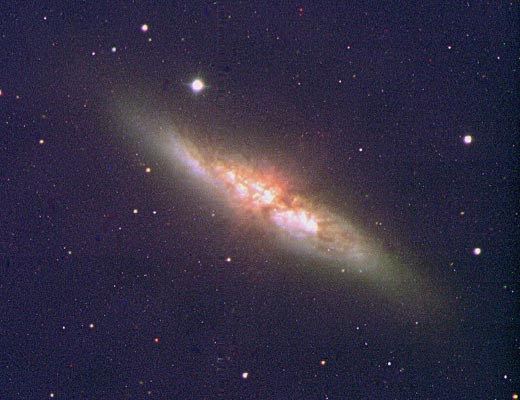
Title:[30401] M82 - NGC 3034
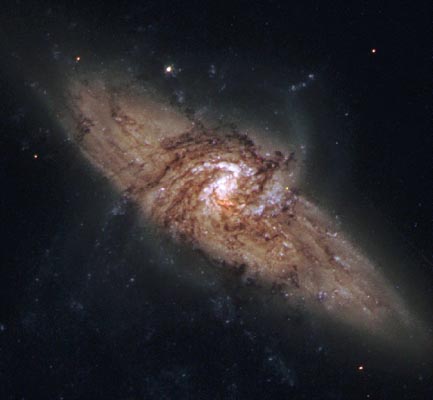
Caption: M82 is the standard example of an irregular galaxy and forms a physical pair with its neighbor M81. The core appears to have undergone a dramatic change in state following a fairly recent interaction with M81. There are large amounts of turbulent gas and dust flow and starburst regions in the plane of the galaxy. The often explosive gas flow is a strong source of radio emission and the galaxy is sometimes referred to as Ursa Major A - the brightest radio source in the constellation. In infrared light M82 is the brightest galaxy in the entire sky.
Copyright:(c) T. Credner & S. Kohle
Credit: T. Credner & S. Kohle, Calar Alto Observatory
-

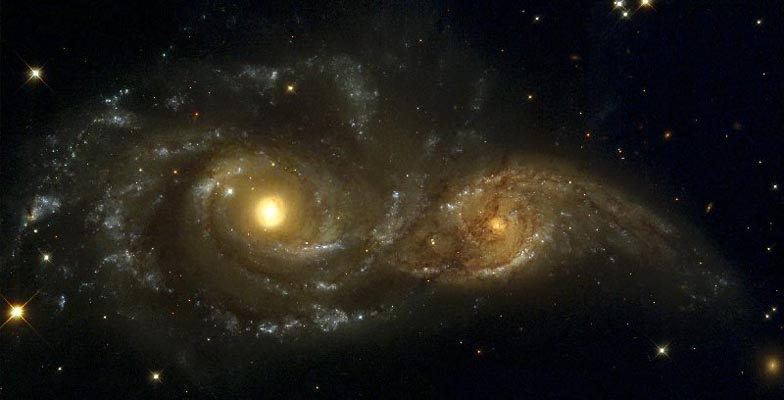
Title:[30601] NGC 2207 & IC 2163
Caption: Two distant galaxies are undergoing a strange interaction. The larger and more massive galaxy, NGC 2207, is on the left. The gravitational forces of the larger galaxy have interacted with its smaller neighbor causing stars and gas to be stretched out over a hundred thousand light years. IC 2163, the right hand galaxy, is moving past NGC 2207 in an counter-clockwise direction, having made its closest approach 40 million years ago. IC 2163 does not have enough energy to escape from its larger neighbor and will eventually be pulled back towards NGC 2207. Eventually, in many billions of years from now, these two galaxies will merge to form a single massive galaxy.
Copyright:(c) Public Domain
Credit: STScI-PRC99-41, NASA and Hubble Heritage Team (STScI)


Title:[30602] NGC 3314
Caption: These two galaxies represent a chance alignment between a face-on spiral galaxy lying in front of another galaxy. Such an alignment provides us with an opportunity to see dark matter in the foreground galaxy silhouetted against the background galaxy. The outer spiral arms of the front galaxy appear to change as they are projected against the galaxy and against the blackness of space. The small, red patch near the heart of the image is the bright nucleus of the background galaxy. It appears red because the light passes through a dust rich volume (the foreground galaxy).
Copyright:(c) Public Domain
Credit: STScI-PRC00-14, NASA and Hubble Heritage Team (STScI)


Title:[30603] Antennae Galaxies - NGC 4038 & 4039
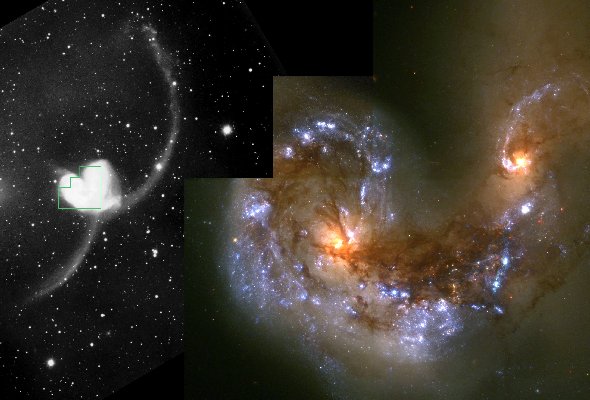
Caption: Two interacting galaxies have given rise to over 1,000 bright, young star clusters. The galaxies are located in the constellation of Corvus at a distance of 63 million light years. In the Hubble Space Telescope image, on the right, the cores of the galaxies appear as the bright orange regions. A huge strand of dust spans the gap between the cores of the galaxies. The spiral patterns, traced by blue star birth regions, are as a direct result of the interactions.
Copyright:(c) Public Domain
Credit: STScI-PRC97-34a, Brad Whitmore (STScI), and NASA


Title:[30604] NGC 4650A
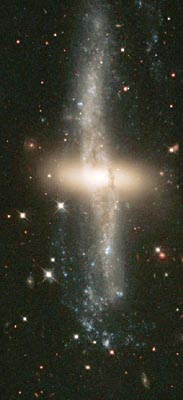
Caption: NGC 4650A is one of only 100 known polar ring galaxies. In this Hubble Space Telescope image the strange nature of these galaxies is starting to be revealed. The formation of such a galaxy is uncertain. It is possible that it is the result of an ancient, at least a billion years ago, cosmic collision. The smaller of the two galaxies being destroyed and its dust forming the huge polar ring at right angles to the original galaxy. The bright central concentration appears to be smooth and featureless, indicating a dense system of older stars and containing little dust of gas. The polar ring does not appear to have any definite spiral structure. The bright regions within it correspond to star birth that has occurred as a result of the interactions.
Copyright:(c) Public Domain
Credit: STScI-PRC99-16, Hubble Heritage Team (AURA/STScI/NASA)


Title:[30605] NGC 4650A
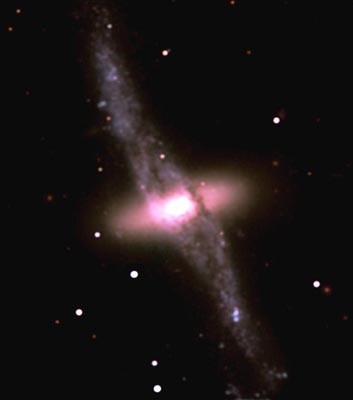
Caption: NGC 4650A is one of only 100 known polar ring galaxies. This VLT image offers a different perspective to the Hubble image. Again the two main components are clearly visible - a small elliptical, or possibly lenticular galaxy, lying perpendicular to a more dusty spiral. The observed motions indicate that a large halo of dark matter exits within the system, although which of the galaxies this matter belongs to is not clear.
Copyright:(c) European Southern Observatory
Credit: ESO PR Photo 19/98


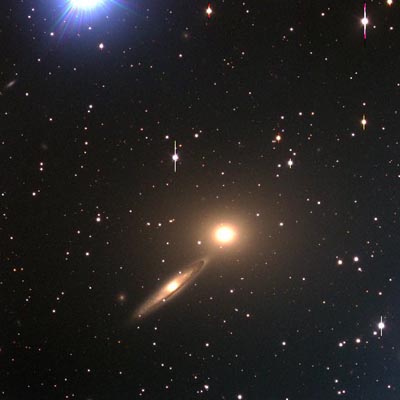
Title:[30606] NGC 5090-1
Caption: NGC 5090 and 5091 are a curious pair of galaxies. Measurement of the distance to the galaxies suggests they are both about 150 million light years away. What is curious about this particular pair of galaxies is that one is a spiral and the other an elliptical. The spiral galaxy has a well-defined spiral arm and dust lane surrounding a bright core. The elliptical consists of a large bright core and tenuous outer regions. There appears to be some kind of interaction between the two at the easternmost end of the spiral arms. Also visible, beyond these two galaxies, is a fainter, distant elliptical galaxy.
Copyright:(c) European Southern Observatory
Credit: ESO PR Photo 20d/99


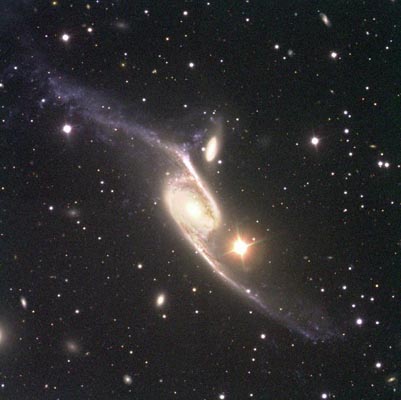
Title:[30607] NGC 6872
Caption: NGC 6872 is a barred spiral galaxy, type SBb, which is interacting with the small lenticular galaxy IC 4970. The upper left spiral arm of NGC 6872 is home to several star-forming regions. This seemingly recent active may be due to disturbances caused by the interactions with IC 4970. The system lies almost 300 million light years away. The galaxy spans 7 arc minutes across the sky, giving it a physical size of 750,000 light years - one of the largest known barred spirals. The object to the lower right of center is a star in our own Milky Way that has been overexposed. Also visible in the background are a large number of fainter, distant galaxies.
Copyright:(c) European Southern Observatory
Credit: ESO PR Photo 20b/99