|
|
by Cveto Pavlin, Gospodarski Vestnik |
'Electronic commerce is an effective tool which enables business partners to make inquiries into the other partner's information system or automatic data transfer from one information system to another. It ensures faster data transfer, the better updating of data and immediate further processing of data. At the same time, it reduces costs, paperwork and the possibility of errors during data transfer', says Pavel Batista, Head of the Research Department at Petrol's Information Technology Section. He adds that electronic commerce is both a challenge and a competitive advantage for Petrol, the national petroleum company.

|
Pavel Batista, Head of the Research Department at Petrol's Information Technology Section. |
Pavel Batista: Petrol, Slovenia's largest oil company, sold about 2.3 million tonnes of petroleum derivatives last year. Total revenue amounted to SIT 121.1 billion. Net profits amounted to SIT 3.2 billion, which represents a 47-per-cent increase on 1996.
In terms of revenue generated from sales of non-fuel merchandise, Petrol has already caught up with a number of medium-sized retail companies. On average 2,200 different articles can be bought at petrol station convenience stores.
Petrol plans to increase sales of petroleum derivatives this year by 2 per cent and sales of merchandise by 7 per cent.
Everyday business processes produce piles of paper documents which
must be in the right place at the right time. As most data transferred
on paper is also recorded in electronic form nowadays, it is possible
to send it through public network systems using information technology.
The whole process then turns into a modern business method, an
electronic method of sending documents - in short, electronic
commerce.
The architecture of Petrol's information system enables relatively
simple building of systems of electronic commerce. They cover
different areas of the information system:
• the
supply of petrol stations with non-fuel merchandise. This involves
articles which are normally sold at petrol stations and which
are provided directly from suppliers or from Petrol's own or distributors'
warehouses;
• the supply of petrol stations with petroleum derivatives;
• business transactions paid by Petrol's own charge card
and other charge and credit cards, which include: electronic data
interchange with banks on payments made, reports on purchases
paid by Petrol's charge card, internet access to data about credit
card transactions, etc.;
• electronic fund transfer;
• the supply of goods for wholesale, which partly overlaps
with the supply of petrol stations with merchandise;
• wholesale;
• retail;
• electronic data interchange of customs data.
Electronic commerce is, generally speaking, a completely new business concept which uses the possibilities offered by information technology, in particular the Internet. It incorporates a number of key elements of modern business and company management, manifested through QR (Quick Response), JIT (Just in Time) and TQM (Total Quality Management). Related to business, modern information technology therefore ensures the punctual, accurate and paper-free flow of information, while enabling the undisturbed and uninterrupted supply of products according to demand. New technologies enable companies to expand their business faster than ever and to act globaly.
'No company
can fully use the advantages offered by electronic commerce if
the majority of business partners (suppliers, distributers, buyers)
is not involved', says Batista.
Electronic commerce in Petrol: this article describes an important
part of electronic commerce in the supply of non-fuel merchandise
in the convenience store area of petrol stations. This is a very
important part of Petrol's business, as the gross margin of these
articles is substantially higher. At the same time, merchandise
provided directly from suppliers or indirectly through Petrol's
own distribution warehouses, complement fuel sales in the convenience
store area of petrol stations.
At some petrol stations non-fuel sales represent as much as 60%
of total sales, a substantially higher figure than that of most
European petrol stations.
|
Pavel Batista: The requirement for
electronic commerce applications is the use of standards. The
EAN-13 standard is used for the unique identification of articles,
organisational units and units of measure. For business documents
the EDIFACT standard is used. For data transfer X.400 and SMTP/MIME
is used. Finally, HTTP, HTML and SSL standards are used for Internet
applications. Electronic commerce calls for a well-regulated information system at both Petrol and its suppliers. The second condition that must be fulfilled is the use of standards. In the near future doing business electronically will become a pre-condition for doing business with Petrol. This business method is regulated in contracts between Petrol and its suppliers. The contracts set out in detail the subject of business operation, the business documents |
to be electronically
exchanged, the conditions for access to specific data stored
in Petrol's information system via the internet, and other obligations
to be fulfilled by both partners. Legislation governing electronic
commerce is not yet in place. 'When we talk about electronic commerce, we are still basically talking about trading. Clearly, the initiators and those in charge of the business process must be the units which are involved in trading and whose primary activity is trade. The process, however, incorporates information systems and technologies without which this type of trade cannot be implemented. The secret of success is therefore the closest possible co-operation between the sales department and information technology department', says Pavel Batista. |
Data on business
transactions (supply of goods, cash, charge card and credit card
transactions) is entered in the central database on a daily basis.
The data is stored at the elementary level for every article.
All Petrol's petrol stations are connected in Petrol's WAN using
an integrated information system. The central operational data
store enables the design of complex electronic commerce systems
and also of data warehouses, which are the basis for building
decision-support systems.
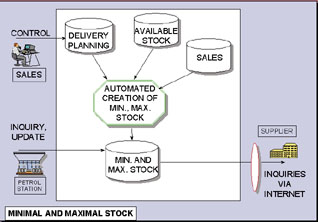
Petrol supports two ways of supplying merchandise to petrol stations:
The first type of supply is entirely left to suppliers, who are
provided with access to data stored in Petrol's information system
via the Internet. As a rule, suppliers deliver goods of which
the available stock is below the minimum level. The quantity of
planned supplies equals the maximum quantity reduced by the quantity
of goods still in stock. No explicit order is needed for this
supply method technique. Station managers control this process
by monitoring and changing computer-calculated minimum and maximum
quantity in stock.
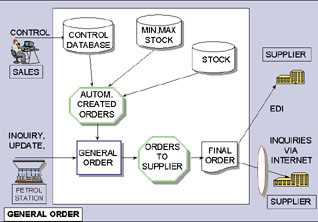
A special software application calculates the minimum or maximum
stock for every petrol station, every article and every month
separately. The basis for the calculation is historic data on
sales over previous periods for every article or substitute, and
data on the frequency of supply of each article. The values thus
calculated are accessed by station managers, who can replace them
with other values according to their judgement. The calculated
or altered values can be accessed by suppliers via an Internet
application, or can be used as the input data in the formation
of generalised orders.
Generalised orders are orders that contain no data on where the goods are ordered from (data on suppliers or warehouses). With these generalised orders Petrol has made the work of station managers easier, since they do not need to know who supplies individual articles and from which warehouse the articles are supplied. To implement this concept a special control database is needed. The control database contains information about supplier, warehouse for each article and petrol station.
|
Pavel Batista: The internet application
for suppliers can be accessed through any browser, so the suppliers
do not need to install any additional hardware or software. Access
to data is protected by means of encryption, user identification
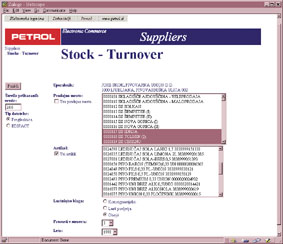
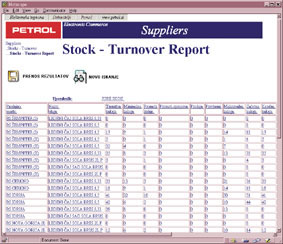
and authentification. The application contains the following
sub-systems: • Stock/turnover
Enables the display of the quantity of stock available, turnover,
minimum and maximum stock quantity for the selected month, sales
outlets, articles, ownership of goods, and the EAN code of the
article. • Supply Enables a display similar to the stock/turnover sub-system, but is adjusted to take the form |
of a document for dispatch to the warehouse manager. • Deliveries
Enables the display of goods deliveries, including detailed data
according to selected search parameters. This selection has a
control significance for suppliers, as they can check promptly
whether Petrol's record of delivered goods corresponds to their
own supply records. • Orders
Enables the display of electronic orders to suppliers according
to selected search parameters. • Sales outlets Displays the list of Petrol's sales outlets, including addresses, telephone numbers, etc. |
Using an internet
application the suppliers access Petrol's information system.
They have access to data on current, minimum and maximum stock
quantity for all articles, monthly turnover (sales, supplies),
and each individual supply and order. The supplier can see the
same data as the station manager. The internet users can transfer
the results of their inquiries into their own information system.
The suppliers can always compare data in its own information system
with the data provided via internet. Station managers control
suppliers' deliveries through the control of the minimum and maximum
stock quantity. The supplier becomes a real business partner fully
integrated into the business process. Apart from access to data
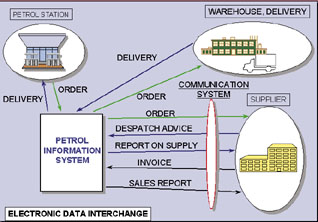
via the Internet, Petrol and its suppliers exchange the following
documents electronically: Petrol's orders to suppliers, suggested
delivery quantities, deliveries of goods which Petrol submits
to suppliers, suppliers' invoices to 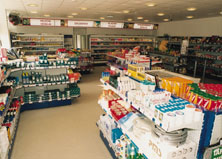 Petrol, and sales report information
which Petrol sends to its suppliers (if bulk buying is the business
method used).
Petrol, and sales report information
which Petrol sends to its suppliers (if bulk buying is the business
method used).
Technologies used for development of electronic commerce systems
in Petrol are: IBM DB2 for OS/390 database management system,
Lotus Domino as HTTP server and application development tool for
Internet applications, and the IBM Visualage Generator application
development tool for other applications.
Pavel Batista: The technological basis of Petrol's information system is computer and communication hardware and software integrated into Petrol's WAN. The main components:
¨ The operation of the main server is monitored by IBM's OS/390 operating system, which is suitable for managing larger computer systems. The operational datastore and data warehouses are built on DB2 platform. The WAN connection is TCP/IP, using ISDN technology for smaller or frame relay for larger locations.
Janez Bencina, General Manager of IBM Slovenija: |
|
WHAT'SE-BUSINESS?It means using Internet technologies and network computing to transform securely customer's internal business processes (via intranets), business relationships (via extranets), and the buying and selling of goods, services and information (via electronic commerce). The Internet is drastically changing the way businesses operate basic business processes, how they merchandise products and how they reach their customers. WHAT TECHNOLOGIES SHOULD YOU USE TO GET THERE?When you want to accomplish real transformation and run mission-critical functions, you need security, reliability, scalability and 24 hours / 7 days accessibility. You need server-centric, industrial-strength enterprise computing. This is the "e" part of "e-business". IBM's products and technologies team can supply the advanced hardware and software technologies to any enterprise that needs to become an e-business. IT'S ABOUT BUSINESS, NOT JUST TECHNOLOGYIs the customer's priority topline revenue growth? Cost reduction? (IDC estimates that companies connected to their customers through the Internet save from 50% to 90% on the cost of sales, customer support and distribution.) Decreasing cycle time? Improving efficiency? Managing the supply chain? Every customer answers these questions differently. IBM, with unmatched experience in creating business solutions, can transform any customer's business by blending standards, Internet simplicity and connections to core customer applications that run their everyday business. |

|
|
YOU DON'T
DO E-BUSINESS,
|
|