|
|
|
||||||
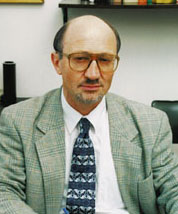
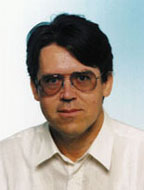
| Prof. Dr Ivan Bratko, Head of the Department of Intelligent Systems and a full professor at the Ljubljana University. | Matjaz Gams, Deputy Head and associate professor at the Ljubljana University. | ||||||
by Matjaz Gams
We are overwhelmed in the information
age by the enormous amount of data available, especially through
the Internet. Intelligent systems and agents provide essential
help in creating or locating relevant, useful and interesting
information. They have become one of the essential areas in recent
years, as indicated by the large number of applications and publications.
For example, the December 1996 issue of the IEEE Expert - Intelligent
Systems had a title "Intelligent Agents to the Rescue".
However,it is not just intelligent agents, all software is more
and more oriented towards intelligent, flexible and user-friendly
systems. It seems that a new generation of intelligent, friendly
autonomous assistants is already on its way.
The Department of Intelligent Systems at the Jo3ef Stefan Institute
is active in research, development and education in the areas
of intelligent agents, artificial intelligence and intelligent
computer systems in general. Technically speaking, their work
embraces machine learning, evolutionary computing, decision support
systems, language and speech technologies, and cognitive science.
Applications are performed in various domains, such as employment,
ecology, medicine, ironworks, and mechanical engineering.
Intelligent agents are personal assistants with autonomy. They are the first generation of computer systems not only to take direct commands, but also to follow more general instructions, while the exact execution is their jurisdiction. We have studied and designed two agents. The most often used is EMA, an employment agent (M. Gams). According to polls in recent years, unemployment is the major national problem in Slovenia. It was a tempting idea to test the new approach of intelligent agents to a problem that directly affects over 100,000 people. The project "Integrated Information System for Employment Optimisation in Slovenia" was conducted in co-operation with the Employment Office of Slovenia. An intelligent agent EMA was developed enabling Internet access to information on available jobs, scholarships and job applicants. EMA can search for links between job applicants and jobs and, if desired, sends e-mail messages to appropriate job applicants when interesting jobs appear. The system is connected to the Internet presentation of the National Employment Office. Approximately 200,000 visits to the Internet site took place last year. The presentation is among the top ten most often visited on the Internet in Slovenia. In 1996, this first project was successfully completed with a working application. At the same time, a new sub-project "Information System for Employment in Slovenia" commenced as part of the "Co-operative Research in Information Infrastructure (CRII) " project.
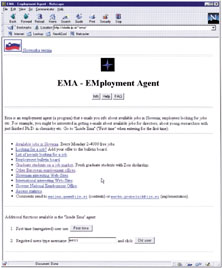
In co-operation with the Slovenian National Employment Office, we have developed an intelligent agent/information system for employment. Through the Internet, the system presents interesting employment information, such as all the vacant jobs in Slovenia, sends e-mails to interested users about specific employment patterns, matches jobs and workers. The top interface is an employment agent EMA (http://www-ai.ijs.si/ema/).
There is plenty of information around in computers; the question is how to deduce anything interesting from raw data. Even reading alone is a very time-demanding task for humans. Until recently, computers did such tasks very quickly, yet very unintelligently. New approaches have already yielded several useful results in such diverse areas as inductive logic programming, computer support for decision processes, integration of machine learning methods, and hierarchical decomposition (I. Bratko). We have designed a relational regression system that has been applied for the prediction of workpiece surface roughness and modelling operator actions in electrical discharge machining. Methods for equation discovery were used to analyse the problem of Ni/Al layers, achieving high accuracy and producing equations that were of interest to physicists. Methods for eliminating noisy examples and irrelevant attributes have also been developed. In the area of using knowledge to conduct intelligent quick search, Constraint Logic Programming (CLP) has been used to find an approximate solution in the molecular energy minimisation problem. Machine learning methods have also been used on the demanding new problem of classifying the NMR spectra of diterpenes, organic compounds that are important for the pharmaceutical industry.
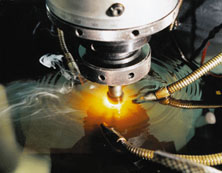
An intelligent system was applied for the optimisation of the electrical discharge machining process.
Computers can be valuable assistants
in various decision problems. We (M. Bohanec, V. Rajkovie) regularly
analyse previously developed multiparametric methods and techniques.
Three real-world problems were recently considered: (1) evaluation
of projects in an enterprise, (2) allocation of housing loans
and (3) decision support for treating nosocomiacal (hospital)
infections.
The last project was conducted in co-operation with the company
Infonet, Kranj. The computer system Ptah was developed, which
is intended to provide decision making support to medical doctors
in relation to nosocomiacal (hospital) infections. The system
is based on a database on hospital infections, which is used to
a time series of microbiological characteristics of selected bacteria.
Four types of time series analysis are supported that help the
doctor estimate the effectiveness of antibiotics, the resistance
of bacteria to antibiotics and the identification of hospital
bacteria. The results of the analyses are displayed graphically.
The Ptah system is in use in the General Hospital in Jesenice.
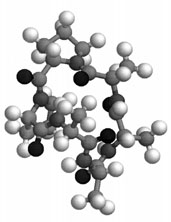
Constraint logic programming was applied on the problem of finding the optimal 3-D structure of molecules. Here it is the Cyclic proline-proline-alanine-alanine-alanine-alanine molecule. Red - oxygen, blue - nitrogen, white - hydrogen, gray - carbon.
In machine learning, important
improvements can be obtained by combining or integrating several
systems and structuring domain data. We have studied different
methods of integrating machine learning systems and shown that
integrating is in general beneficial in real-life circumstances.
However, certain constraints have shown up. For example, the greatest
improvement usually appears with 2-5 systems while improvements
usually deteriorate with too many systems. Overall, an essential
improvement can be obtained with additional effort, which is worthwhile
if the aim is to achieve top performance. This was proven in several
practical applications, e.g., in ACRONI Steelworks in Jesenice,
Slovenia, where a multiple AI system has been in regular use for
over 7 years, representing the major industrial AI application
in Slovenia (Gams).
We have also shown that improved new definitions of the target
concept can be designed in terms of a hierarchy of intermediate
concepts and their definitions (B. Zupan). This effectively decomposes
the problem into smaller, less complex sub-problems, and decomposes
an initial set of examples into smaller, more manageable sets.
Since each example set partially represents a function, the process
is called function decomposition. Initial experiments on artificial
and real-life datasets indicate that the approach produces good
generalisations with high classification accuracy and is able
to discover meaningful concept hierarchies.
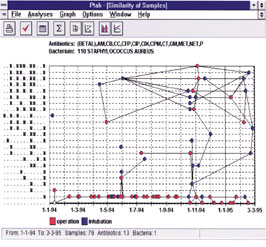
The PTAH system helps doctors to determine the resistance of bacteria to antibiotics.
Evolutionary computing tries to adopt principles of evolution in computing. We have focused on the development and hybridisation of evolutionary algorithms, such as genetic algorithms, for solving complex optimisation problems (B. Filipie). In the area of dynamic systems control, these algorithms were employed to derive control rules for a model container crane. This resulted in control which mimics the operator's performance, but is more efficient due to the chosen criteria. The approaches have been tested with numerical simulators and with a physical model of a crane (T. Urbaneie). Similarly, the membership functions of a fuzzy control system for a pilot wastewater treatment plant were optimised. In co-operation with the Faculty of Mechanical Engineering, University of Ljubljana, we carried out optimisation of the process parameters for continuous casting of steel at the ACRONI Steelworks in Jesenice.
A new method for Slovene speech synthesis has been applied. A representative set of speech samples was collected. A database of Slovenian diphones was collected (1200 of them) and formulae were created for intonation flow and the pause length. We have created a tagged corpus of 300,000 words, a set of tags (1500 tags), and a computer dictionary (15000 lemmas). The corpus and the dictionary are the first widely available resources of their kind for the Slovenian language (T. Erjavec).
Are humans nothing but complex computers? Weak artificial intelligence (AI) and cognitive sciences study differences and similarities between computers and humans. Our studies are concentrated on multiple models of knowledge and self-reference. Among other things, we have shown that in the Penrose vs Sloman debate about Goedel's sentence, Penrose correctly analysed the mapping while Sloman did not. Self-reference is treated as the foundation of systems capable of insight into their own functioning.
Medicine, because of its complexity, is often analysed with AI methods. We are developing and applying specialised methods for analysis of clinical databases, based on inductive machine learning, clustering, fuzzy sets, Bayesian classification and statistical methods (N. Lavrae). AI methods also enable modelling and acquisition of medical knowledge and help in various medical decision support problems. We have applied these methods in several oncological domains, e.g. when searching for a primary tumour, searching for appropriate classifications in breast cancer and lymphography cancer. Analysis of malign cells of breast cancer were performed for distinguishing the degree of degeneration between cells. We have forecast survival times for patients with anaplastic carcinoma of the thyroid gland. Other medical domains include diagnosing progress of coronary artery diseases, ischemic cardiac diseases, the outcome of severe head injuries, diagnosing sport injuries. Complications after treatment of fractures have also been analysed.
Several techniques of intelligent systems can be used for analysing ecology problems. We have used machine (equation) discovery methods to automate the modelling of the processes of algael growth in the Lagoon of Venice and phytoplankton growth in the Danish lake of Glumsoe (S. D3eroski). The use of machine learning for biological classification of British rivers and analysis of biological and chemical data on river water quality in Slovenia has also been considered.
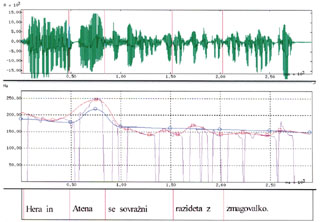
The panel displays speech signal, original intonation contour (indicated by red line and squares),
and generated intonation contour defined with functions in our text-to-speech system (indicated by blue line and circles) .
The department has well-established
international links, many of them through European projects and
networks of excellence: "ESPRIT Project Inductive Logic Programming
(ILP) II", the COPERNICUS Project "Multilingual Text
Tools and Corpora for Central and Eastern European Languages",
and the "Information System for Employment in Slovenia"
as part of the "Co-operative Research in Information Infrastructure
(CRII) " project. The department is a node in the following
networks of excellence: "ESPRIT Network of Excellence in
Computational Logic", where it co-ordinates the area "Computational
Logic and Machine Learning", "ESPRIT Network of Excellence
in Machine Learning", "ESPRIT Network of Excellence
in Evolutionary Computing", and "COPERNICUS Concerted
Action Trans European Language Resources Infrastructure.
Members of the department have published several monographs internationally,
are members of several editorial boards of established journals,
and cooperate intensively in Informatica, the fully international
computer journal published in Slovenia.