|
|
by Professor dr.Janek Musek |
A number of definitions and
conceptions of values can be found in both philosophical and psychological
or sociological axiology (Musek, 1982; Musek, 1993a). two broadly
accepted definitions could be mentioned here as examples. Clyde
Kluckhohn (1951; Musek, 1993a) defines values as concepts of the
desirable, which influence how people decide on actions and how
they evaluate events. And in terms of English and English (1972;
Musek, 1993a) "the values are abstract, often implicit conceptions,
which define to the individual the goals or means for attaining
the goals he considers as desirable". Very often cited characteristics
of values are the evaluative note, abstractness, cultural sharing
and obligatory personal involvement.
Some years ago, I proposed a somewhat different model of values
(Musek, 1982). According to this proposition, values could be
understood as motives or motivational goals on a very high level
of generality (see also Schwartz and Bilsky, 1987). They could
be conceived as general and relatively consistent ideations of
goals and events, which we highly estimate, which refer to broad
classes of subordinated objects, actions and relations, and which
direct our interests, attitudes and our behavior. Values can then
be viewed as the most general motivational goals, occupying the
top of the hierarchy of such goals.
Values can be classified into
a number of categories, occupying different levels in the hierarchical
structure of human goals. Numerous categories of values at different
levels of hierarchy have been identified in theoretical and empirical
investigations. In our own research, a clear hierarchy of categories
of values emerged as a result of factor-, cluster- and other multivariate
analyses (Musek, 1993a; Musek, 1993b; Musek, 1994).
As can be seen from Figure 1, the results of factor and other
multivariate analyses confirmed the hierarchical structure of
values. According to this structure, values can be classified
at different levels of generality, from the most general at the
top, to the most specific at the bottom. At the most general level
of the entire structural hierarchy, there are only two very large
categories (macrocategories) of values (Dionysian and Apollonian
macrocategories). On the next level, each of these two categories
splits into two further subcategories, which could be called value
types. Dionysian values could be subdivided into two groups, hedonistic
values and potency values. The first group (hedonistic values)
contains values connected with sensual and material pleasures,
while the second group (potency values) includes values which
have to do with achievement, success and reputation, but also
with patriotism. At the next level, each of the value types could
be further divided into the middle-range categories of values.
Thus, the hedonistic type disjoins into sensual and health categories,
the potency type into status and patriotism categories, the moral
type into traditional, democratic (or societal) and social values
and the fulfilment type into cognitive, cultural, self-actualising
and spiritual values. Finally, at the most specific level of the
hierarchy, we find various single values, which can be derived
from the middle-range categories of values.

|
| Figure 1. The four-level hierarchy of values. It includes the level of macrodimensions, the level of value types, the level of middle-range value categories and the level of specific values. |
Interestingly enough, the content
of four value types resemble an ancient oriental classification
of values. According to this classification, the values emerging
earliest in the life of a human being have to do with life pleasures
and the satisfaction of sensual and physical needs. At the next
stage, values connected with success, achievement and reputation
take over. In the next phase, the individual becomes more and
more occupied with values regulating his duties and responsibilities.
And finally, he achieves the level of progressive orientation
toward the values of inner life, of spiritual life and self-transcendence.
Indeed, these four categories of values very well correspond to
our four types of values: hedonistic values, potency values, moral
values and fulfilment values.
We may hypothesise therefore that the relative importance of clustering
values will be shifted from hedonistic and potency values to moral
and spiritual (self-growth) values during the life span of individuals.
The results of our investigation indeed confirmed connections
between the age of the subjects and the rated importance of values.
The correlations between age and ratings for the two largest and
four more specific categories of values are presented in Table
1.
The results clearly show that the importance of Dionysian values
decreases, and the importance of Apollonian values increases with
the age of our subjects. At amore specific level of value dimensions,
the hedonistic values and potency values tend to decrease and
the fulfilment values tend to increase during the life span of
an adult person (moral values remaining more or less stagnant).
A developmental hierarchy of values is interesting not only because
it fits a traditional philosophy and even folkloristic theory
of values, but still more because it throws some new light on
puzzling phenomena like the notorious value conflict between generations.
It is possible that the conflict between generations reflects
the different value orientations resulting from the normal, developmental
change (or shift) in the hierarchy of values. In some way, for
instance, fifty year old persons are in the value conflict with
themselves in their twenties. The fact that the value conflict
between generations is a perpetuating phenomenon - not a characteristic
of just two or more present generations - is quite in accord with
this explanation.
| Table 1. | |
Correlation between categories of values and age. |
|
| CATEGORIES OF VALUES | CORRELATION COEFFICIENTS |
| APOLLONIAN VALUES | .27 |
| DIONYSIAN VALUES | -.51 |
| hedonistic values | -.24 |
| potency values | -.41 |
| moral values | .06 |
| fulfilment values | .41 |
Despite the fact that value
systems are by definition rather stable and resistant to change,
we may expect that they cannot remain unchanged in confrontation
with a large societal transition such as occuring in post-communist
countries in Europe.
Changes in psychological and psychosocial domains were detected
in post-communist countries even before the beginning of political
and economic transition. They included the disintegration of the
socialist ideology and value-system (vastly supported by the previous
political regime), accompanied with an invigoration of political
autonomism and a simultaneous increase in pro-individual, entrepreneurial,
pro-democratic, pro-religious and pro-nationalist orientations.
There is a common observation that the intensity of these changes
correlated with cultural and historical factors, including closeness
to the western or central-European tradition (with historical
passages through the Reformation, Counter-Reformation and Enlightenment
phases), the commitment to the Catholic rather than Orthodox religion,
adherence to an individualistic rather than collectivistic culture,
etc. For these reasons, Slovenia is maybe better equipped for
transition tasks in both economic and psychological respects.
The major change in value orientation observed in Slovenia (with
similar trends elsewhere in former socialist countries, especially
in Central Europe) during the period from 1988 to 1994 is a significant
increase in the rated importance of dionysian values (see Figure
2a). Dionysian values increased constantly while the apollonian
values remained approximately at the same level. We can see that
the raise of dionyisian values is due to the increments in both
hedonistic and potency value types (see Figure 2b). The moral
value type remained more or less stagnant during the period of
measurement, while fulACfilment values showed a significant decline
in 1991 and then rose again in the following years.
Value types could be further divided into various middle-range
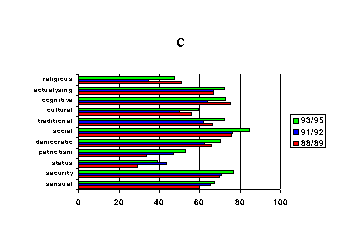
categories of values. As shown in Figure 2c, the most significant
changes were recorded in patriotic, status and sensual values,
which consistently increased. Social and security values also
increased, but only in the period after 1991. The other categories
remain mostly at the same level (democratic, cognitive and traditional
values) or even decreased in the period from 1988 to 1991 (cultural
and religious values).
The observed changes and shifts in value orientation are congruent
with political, social and economic changes in the pre-transition
and transition periods in Slovenia. The changes in value orientation
indicate a rise in individualism, competitiveness and nationalism,
all embodied in dionysian values, in hedonistic and potency value
types and particularly in status, sensual, security and patriotic
values. This picture can easily be associated with the dominant
changes on the political and economic scene: the transformation
of a totalitarian system into pluralistic democracy and a progression
from a socialist to a market economy. The rise of patriotism and
nationalism in the transition period is very understandable in
the circumstances of Slovenia, whose struggle for independence
culminated successfully in 1991.
Nevertheless, the changes in value system - although significant
- are not very dramatic and they could even lessen in the near
future. The observed modifications in value orientation reflect
probably not only the realm of transitory processes, but also
the specific situation of Slovenia, with its historical, cultural
and geographical inclinations.
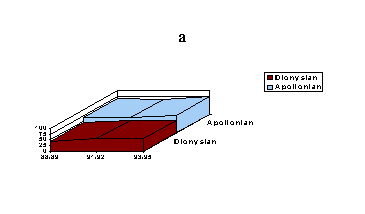
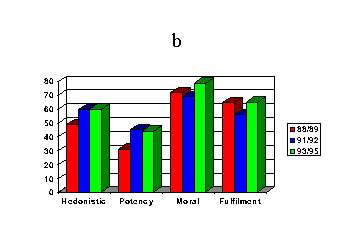
Figure 2. Observed shifts in the ratings of the importance of values in the period 1988 to 1994 in Slovenia: (a) the macrocategories (Dionysian and Apollonian values), (b) value types and (c) middle-range categories.
English, H.
B. & English, A. C. (1972) Obuhvatni reenik psiholo1kih i
psihoanalitiekih pojmova. Beograd, Savremena administracija.
Kluckhohn, C. (1951) Values and value orientations in the theory
of action. In: Parsons, T. & Shils, E. (Eds.) Toward a general
theory of action. Cambridge (Massachusetts), Harvard University
Press.
Musek, J. (1982) Osebnost. Ljubljana, DDU Univerzum, (in Slovene).
Musek, J. (1993a) Osebnost in vrednote. Ljubljana, Educy, (in
Slovene).
Musek, J. (1993b) The universe of human values: a structural and
developmental hierarchy. Studia Psychologica, 35, 4-5, 321-326.
Musek, J. (1994) Values and value orientations in the background
of European cultural traditions. Anthropos (Ljubljana), International
Issue.
Schwartz, S. H. & Bilsky, W. (1987). Toward a universal psychological
structure of human values. Journal of Personality and Social Psychology,
53, 3, 550-562.