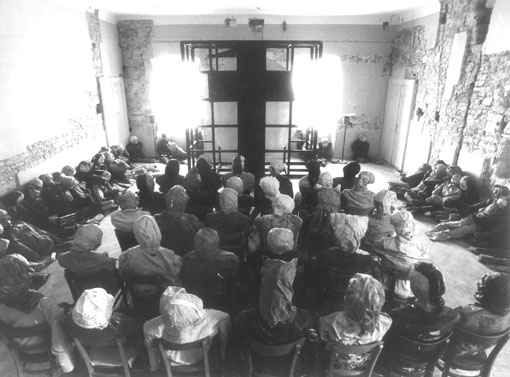
The cross placed in the centre of the "Konstruktor"-Group creation, named "Terapia Provocatoria" does not represent a symbol of Christianity and logocentrism.
For the religion, the cross represents grief and sacrifice, castration and submission, hierarchy and apathy, therefore it is "the symbol which must fall", and with it must fall the terror of every pure idea and certainly, and must fall every god constituting a "terrible knot". We should perhaps quote poet's words; 2For 757 centuries the evil has been spreading and killing; for two thousand years it has been restraining and nailing down. But the things do not want to pass either through the cross or through the circle. The cross is part of the fence, it is a rotation of a knot, the confluence that stops every possibility.
"Konstruktor" therefore purifies this symbol of the debris of history and ideology, so that the cross loses its naration definition and contens connotation. The cross is an absolute source of meaning in general, an inherent measure of value and signification, but considered alone as measure it has no value at all. The cross is a sign which - according to Derridas - "opens the phenomenon of significance", but such position at the origin sets it outside any conception, marking it in this way as a temporal, transobjective condition, sort of transcendence.
The source of meaning contained in the cross, taken as symbol transcends the world of signs which sets the values of all other meanings of contens and history, off all "translations" into historic facts. The cross possesses an ideal "Bedeutung" and represents a form of pure autoaffection which is reduced to a symbol. It is actually a "transcendental reduction", which does not require any outer, supreficial explanation. It is actually an ideal of pure object, bearing inside an original and independent meaning.
The original impression of the cross represents the absolute beggining of any other additional empirical contens and significations. The substance of this sign is in this way separated from its attributes; the exibition in the Gallery represents an "arhaic structure", a scenography without history. The cross structure in this case represents only a construction of a metalinguistic model, and its historical dimension is only the background of the installation. The sign covers all contens, without letting any of them prevail over others, therefore the contens correlation has no importance.
Beside the cross, the basic message of the Konstruktor's instalation, is the meaning of death, not considered in a sense of personal experience, but as an element of existence, of the whole existence. Death is taken as the final opportunity and the fundamental way of human existence, without any ideological superstructure. The death is a marginal situation, connected to anguish, fear and absolute certainly. But for the mentioned installation presented in exibition, the significance of death as a total and/or totalitarian form, is more important, than the individual experience of death seen in the sense of existentialist orientation.
Consequently, the autors have not emphasized the sociological, psychological, social and political dimension of death. The work does not represent a historical, concrete allusion of the events we witness today, that is the allusion on which other interpreters of the Konstruktor installation have stranded (interpreters of the same installation presented in Zagreb and Ljubljana), by judging only the immediate impression.
The installation's main theme is death as absolute, non-temporal fact. In this sense, death is considered as condition leaving no way out; death is nothing and nothing can be found behind it.
When we face the death, we can experience its clear, evident nature; we cannot find any other or differing explanations for it. The "marginal situation" is not anymore a condition of consciousness; such situation cannot be scientifically determined. We cannot aproach ist source by reasoning, but only by living the unique ecstatic experience. The "marginal situation" belongs only to the authentical experience of existetce considered as a whole, and it cannot be equalled by any separate, individual perception.
The existential elements such as sorrow, anguish, fear are clearly connected to "every day" existence. We can feel the "Alltaglichkeit" as genuine, realistic re-experience; we can feel the unpleasantness, the horror, we can talk about concrete phenomena of death.
However, with Konstruktor's installation the matter in question is another. Death is not considered here as a "cases of death", but goes rather near the expression "essence-existence - toward death".
We hide ourselves in day-by-day recurrences to escape the real meaning of death, meaning which is alienating from us the genuine opportunity of an existential "former-being", taken as "death-being". The mere evident fact of its everyday experience does not mean that we have finally experienced it as a marginal existential form. Hence, death taken as everyday temptation, as objective fact, does not represent a "marginal situation". The fact disclosed by the so-called death, is actually only an appearance, not the essence itself. The essence is connected to the average, impersonal daily recurence when opposed to death conceived as the most appropriate human possibility, as "fixation", or even better as "foundation", metaphor, symbol or ecstasy.
Yes, an ecstasy not bound to fear or anxiety, since anxiety discloses emptiness, which in this case is not exposed at all. Or perhaps it really is exposed if we take the emptiness as "openes of death". Since our intelect can conceive only "something", for instance a real end of life, it becomes somewhat "dis-connected" to its natural logic, therefore we must "re-connect" it to transform the conception.
The transformed consciousness about the time of death, which defines our lives to a great extent, can thus bring us a conception of "the space of emptiness"; the space which oppresses, even clenches us with anxietyof "the space of emptiness"; the space which oppresses, even clenches us with anxiety.
The authors of the exibition consenquently have decided for a dedicated and ecstatic model of conception of a genuine existence, conception containing simultaneosly the certainty and the unsurpassed possibility. Death, as total and/or totalitarian form is conceived by them as the most appropriate possibility to fulfill the human beig, to elevate him over the impersonal "everyday recurrences". What matters here is the enlightenment of existence and the leap forward to the existential selfrealization. This one being rather the consequence of existential temptation and temporal ecstatic decision, than the result of knowledge. This selfrealisation of the individual facing a "marginal situation" as presented by Konstruktor's installation, is reffering to the Being as a whole, to an inner "purification". The exibition sub-title is namely "Terapia Provocatoria": hence provocation and simultaneus recovery.

