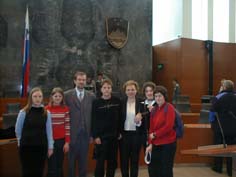
SLOVENIAN STUDENTS DEBATE ABOUT THE EU IN THE SLOVENIAN
PARLIAMENT
2nd
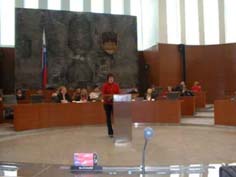
April, 2004 was an exciting day for 120 Slovenian students.
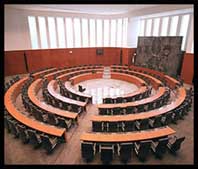
At 9:00, they, along with their mentors met in the Slovenian
parliament in Ljubljana to discuss and debate upon the
future of the EU and the role that they will play as future
European voters and possibly members of the European parliament
as well. The meeting, organized by last year's Spring teacher, Mrs. Janja Jankoncic Faganel,
from Gimnazija Poljane,
was hosted by Mr. Alojz Peterle, former member of the
European Convention and president of the Slovenian Parliamentary
Commission for European Affairs, who was very tolerant
and didn't let any question go by without an answer. He
didn't leave anyone disappointed.
There
were 10 student speakers from the attending schools who
focused on the advantages and disadvantages of Slovenia's
entry into the EU as they see them and highlighted some
of the key issues that are on the agenda in the European
parliament today.
The students acted like real politicians, questioning
and giving their opinions about recent developments in
the EU and their expectations after the enlargement. Their
greatest interest lay in the possibility for further education
in another EU country.
Eva
Ule from Osnovna sola Pivka was quite optimistic about
the whole event. She focused on the importance of events
like Spring Day that bring young people of Europe together.
Here is part of her speech.
'Spring
Day is a relatively new, but important and necessary project.
I was already enthusiastic about it last year, because
I think that presenting Europe and the EU is interesting
and at the same time educational. Judging from experience,
I can say that young people learn a lot more from activities
that are not compulsory. Days like Spring Day play a very
important role in our future lives. We will live in an
environment that is unknown to our parents. We will be
able to take a walk through this continent and admire
its beauty without any major obstacles in our way like
borders. It will be easier for us to get to know our peers
in different countries and compare our schools with theirs.
Collaboration and participation between schools will be
more important more than ever before. So, we should get
to know our neighbours better and accept them for what
they are. Our school has been making efforts in this direction
in many international projects.
Even though Europe is quite a small continent, its inhabitants
are very diverse and don't know very much about each another
yet. Each country has its own traditions and customs,
its own way of life. What we have to learn is to judge
a person from the inside. That is why values like tolerance,
equality, solidarity and others play such an important
role in learning to live with one another in the same
European space. My friend, Ana, said that the EU will
be important for us, because our future will grow and
develop in it. That is why we have to prepare ourselves
now for what is to come. A better time couldn't have been
chosen to celebrate Spring Day in Europe than Spring itself.
The beginning of Spring and the beginning of a new era
for us and for the new EU countries. As nature revives
itself, so will Europe be reborn and begin living a new
life.'
Miha
Schnabl from Gimnazija Poljane analysed the history of
Slovenia and gave his view of our country's position after
the enlargement.
'The
history of the Slovenian people is a history of a people
who have for decades and centuries suffered because of
their smallness and subjugation to the rule of other nations.
On 1st May, 2004 Slovenia will become a fully authourized
member of the EU. She will become a part of the 'new'
united Europe, which is based on the principles of freedom,
democracy and human rights.
Despite the just recent birth as a completely independent
county, Slovenia has been able to attain a level of democracy
and respect for human rights that places her among the
highest in the world. With her quickly obtained democracy
and economical recognition, Slovenia has succeeded in
becoming a country which is spoken of as a success story.
However, we must not be too easily satisfied. We must
continue to strive for newer and higher goals.
Of course, we cannot maintain that everything in Slovenia
is in order. The high level of unemployment is one of
the biggest problems. We realize that it is not possible
to completely do away with unemployment. Together with
corruption and the growing of social differences, unemployment
has become a joint European problem. Europe is, however,
a new challenge, a challenge which has required considerable
adjustments and compromises on the part of Slovenia.
There are many reasonable doubts surrounding our membeship
in the EU. We must realize that inspite of equality and
equal rights on paper, within the EU there are still large
discrepancies regarding the strength of individual countries.
There are the large countries with a little more influence
and thus more rights, and the small countries with a little
less influence and thus fewer rights.
1st May will not bring any major changes to the average
Slovenian family. The effects (positive or negative) will
be felt after some months, even years. The EU, of course,
is not ideal. But for the moment it is the best alternative.
In fact, it is the only alternative. Isolation would be
an economic disaster for Slovenia. Slovenia must become
an active partner in the EU. She must be ready to express
firmly and clearly her point of view on any dilemma or
question that arises. Indecisiveness and non-participation
will not give Slovenia the status she needs as a country
with definite goals and as a good partner with clear and
firm points of view that she is prepared to and capable
of arguing and, of course, always open to compromise.'
Giving young people the opportunity to express their thoughts
and views on important issues is a vital necessity in
today's world. They must not be left in the dark. It is
not only the young who benefit from this guidance, but
also the society in which they live. We must remember
that they will be the leaders of tomorrow.
prepared by:
Spring Teacher 2004
Magdalena Bobek
|