 SUSTAINABLE
DEVELOPMENT SUSTAINABLE
DEVELOPMENT |
|||
|
|
|
What is it?
Sustainable development is a collection of methods to create and sustain development which seeks to relieve poverty, create equitable standards of living, satisfy the basic needs of all peoples, and establish sustainable political practices all while taking the steps necessary to avoid irreversible damages to natural capital in the long term in turn for short term benefits by reconciling development projects with the regenerative capacity of the natural environment.” (From Wikipedia, the free encyclopedia)
Milestones - Stockholm, 1972 – Environmental conference: With the declaration of the UN Conference on the Human Environment environmental ethics was established with 26 principles enhancing worldwide action for preservation of the environment. - Rio de Jeneiro, 1992 – UN Conference: By signing Agenda 21 the worldwide action was redirected to global problems. The emphasis was on the long-term meaning of the natural habitat for better future of humanity on all levels. - UN Johannesburg Summit 2002: The action after Rio was confirmed not to be adjusted and carried out insufficiently and too slowly. New and less extensive goals were set at the conference. The definition of sustainability not being the environment only, but also economy and social affairs was confirmed. - New York, 2002 – United Nations General Assembly, 57th session: The decade of educating for sustainable development (2005-2014) was proclaimed by Unesco. The emphasis was on the educational quality in the following fields: environment, low consumption, water, sustainability in tourism, equal opportunities, human rights, rural development, sexual equality, health promotion, HIV/AIDS, media and educational technology, intercultural understanding, cultural diversity, human knowledge. Values of sustainable development must become a part of human consciousness.
Futuristic school today! Upbringing and education on all levels have the primary role in accomplishing sustainable development. In its vision a school should define the values of sustainable development. Those values should be taught, explained, substantiated, experienced and personalised. Learning process is enriched with numerous contents, forms and methods of work, which enable pupils to develop their skills of observation, communication, opinion evaluation, argumentation, cooperation, problem solving, theory and practice connection, consequence foreseeing, activity planning to do away with negative consequences, etc. Pupils are thus becoming more and more active, they learn from theory and experience, they look up to nature and the opportunity of realising their ideas. Teachers are mostly planners, organizers, directors and observers, who are teaching, leading and giving pupils example of how to use acquired skills in the future to assure sustainable development. They act as a team, since the boundaries between the carrier and the recipient is blurred. Therefore, learning for sustainable development is cooperative, independent, on one’s own initiative, extracurricular – it will become an all life process.
Learning for the sustainable way of life is all of those things and more …
Contents Our goals
How does our tree grow?
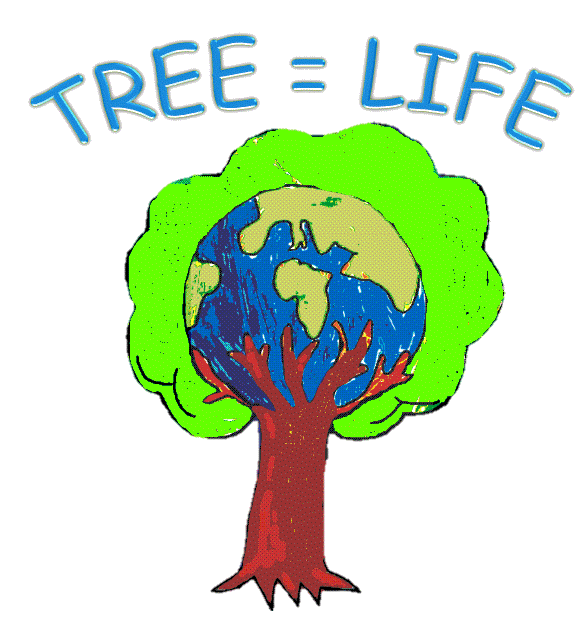
The international project THREE=LIFE will be systematically and gradually built throughout the decade. Each school year the tree will be a topic seen from a chosen point of view, which can be physical or metaphorical (e.g. environmental, ecological, botanical, sociological, artistic, historical, geographical, biographical, etc.) Within schools the project is carried out during lessons and other activities throughout the school year.
|
|