VERNACULAR POTTERY AND GUILDS
Nataša KonestaboIndividual crafts became important in
those villages where the natural conditions were right; pottery developed everywhere where
loamy, sandy soil had a negative effect on the harvest. Where the rural economy was able
to combine the production of raw materials with crafts (cooperage, shoemaking, the leather
industry, tailoring, strap - making, milling and wheelmaking), crafts became specialised
as a house tradition in certain families, with the result that the craftsmen joined
together to form guilds.
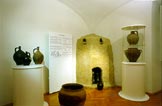
The founding of guilds in Prekmurje
did not revolve around town areas but to parish centres or the estates of landowners. The
acquisition of guild privileges required years of collecting together resources, which
eventually reached its peak in the guild charter, the most important document of central
authority. The artistically - crafted safe in the exhibition is surprising because of its
ornamentation and unique lock mechanism. The guild charter in the exhibition is the
document by which Maria Theresa approved with her signature the association of craftsmen
from the parish of Beltinci - blacksmiths, locksmiths, strap - makers, wheelwrights and
millers - into a guild. A distinguishing feature of the tankard of the tailors' guild is
the use of the technique of faience, which contributes, with its rich bright
colours, to the Baroque splendour and recreates an era in which the guilds in Prekmurje
truly flourished.
Folk pottery was susceptible to
numerous influences which came to the countryside from more developed areas, sometimes
after a delay of several centuries. Among those most eagerly adopted were improvements in
technique which gave greater durablity and colour to the fragile pots than was possible
with natural glazes. Greater impermeability and durablity were achieved using lead
glazing, which began to be used in folk pottery in the 18th century. The
brightly - coloured effectiveness of simple geometric forms was achieved by adding
coloured metal oxides. Changes in the domestic culture in the region as a whole, which
enabled the transferring of most everyday activities to the kitchen, gave rise to a need
for a more durable glazing and containers with greater plasticity. The original functional
nature of dishes and pots (known as pütre) was overtaken by a decorative function.
The reconstruction of a quarter of an ancient kiln illustrates a special method of
reduction firing, which has only survived in Prekmurje, and an ingenious way of solving
the problem of stability. The black fired pot, which was notable for its low permeability,
was placed in the kiln in such a way that the heat did not destroy its stability. The oven
was protected from the vagaries of the weather with a hut, or covered with straw, so that
firing could also take place in winter. |