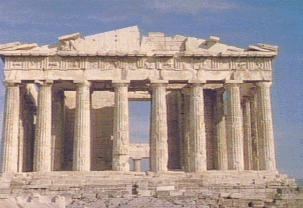
Zlati rez - čudežno razmerje, ki je prijazno očesu in ima v človeški zgodovini posebno mesto na veh področjih
Zgodba se je začela v antični Grčiji.
The Romans are not famous for their conquests in mathematics so much as they are known for their military conquests. In fact, the Romans' application of the Golden Ratio was not original. Instead, as they conquered Greece, they adopted most of the Greek culture.
However, the Romans advanced the Golden Ratio in their own way. Virgil's Aeneid was analyzed at Princeton during the 1940s, and the proportions of lengths of paragraphs were close to the Golden Ratio. The Roman state extended its influence over most of Europe and Northern Africa for several hundred years, and spread aspects of Greek culture--including architecture--into these areas. Later, when the Roman empire fell to Germanic tribes, ideas and influence continued to be spread into the Middle Ages.
The Pythagoreans were a cult that lived about 2,500 years ago. Their leader was Pythagoras of Samos, who developed the Pythagorean formula and identity. Pythagoras and his followers made many contributions to math, astronomy and music.
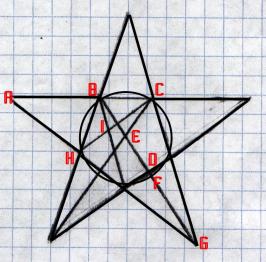
The holy symbol of the Pythagoreans was the pentagram, or star, above. They found the relationships between the segments fascinating.
Was the pentagon as important during the Middle Ages through Renaissance as it was during the time of Pythagoras? Definitely. In fact, until the Middle Ages, no one realised exactly how important it was. Only then was the particular proportion of its elements was considered divine and attributed an unique mysticism.
Okay, it's not every day that you hear about mysterious pentagons. The reason that it was so mysterious was that not everyone could draw one. Making an exact construction required a compass, and the only people with those were artists. That really upset some pentagon fans, but it made the artists seem pretty important, so they weren't about to change things.
In Stephan Lochener's painting "The Virgin in the Rose Garden" a circle tangent to the sides holds a double pentagon. One of the pentagons is at the bottom of the painting, placed an equal distance from the parts determining the circle. Certain diagonals of the pentagon are extended make the construction of the arbour. The small wall that surrounds the Virgin follows the arch of the pentagon at the top of the picture.

After the Middle Ages, the pentagon continued to be used in some parts of the world as a sign that represented the craftsmen. Most of the time this sign was placed next to where craftsman's name was carved on his work.
The publishing of Fra Pacioli's book "The Divine {roportion", in Venice in 1509 turned its subject from a memory of the past to the news of the day. Pacioli's work, with paintings made by Leonardo da Vinci, established five proprieties which makes the golden ratio worthy of the name "divine"(or "dal ciel mandata"):
1. As God, it is unique.
2. As the Holy Trinity it consists in the unity in three, being made of three terms.
3. As God can not be defined in words, it can not be expressed in a rational number.
4. As God, it is always equal to itself.
5. As there are four elements, which form all of nature, so the holly proportion permits the construction of the Dodecahedron, the expression of quintessence.
Even if Leonardo da Vinci had collaborated with Pacioli in his work and is now attributed with making much progress with the Golden Ratio, he did not take great interest in it in his manuscripts or in his works. Even if he used it, that proves only the power of tradition; for Leonardo, the golden ratio was not a new idea. However, from then on the golden ratio would enjoy the same attention as the musical ratios in the works of theory that were more and more popular among artists. However, saying that the Golden Ratio was used in the Renaissance the same way it was in the Middle Ages would be an error.
In the Middle Ages the composition was based, in general, on a Pythagorean geometrical figure; the complex pattern is followed to the smallest bit of detail, but most of the time hidden from the profanes--the non-artist community. The usage of the pentagons in art was unsophisticated--artists used them to place surfaces in an aesthetic arrangement, but never realised the complexity of what they were dealing with.
The disbelief and continual lack of interest in the Golden Ratio shown by the painters of the time eventually turned into a simple habit of placing a composition a certain distance from the frame; an almost instinctive operation.
For example, when Vermeer created "The Painter's Workshop", he filled the space with tables, chairs, an easel, curtains...basically with lines, planes, angles and perspectives. Being brought to the surface of the painting, these lines are part of a network composed by orthogonal and oblique lines afferent to the golden ratio. But wait, there's more: Vermeer seeks to render the exact perception of the objects by using contrast between colors to create light and depth.
    |
The Germans, influenced by mathematics of the time, brought the Golden Ratio to light once again during the early nineteenth century. The father Didier(P. Lenz) made the "holy measure" the artistic creed of the Benedictine monastery from Beuron.
The French artists had known the golden ratio through Serusier. Serusier, who published his book, "ABC de la peinture" in 1921 , was teaching his students at the Ranson academy as early as 1908 the principles of the Golden Ratio.
The cubists (Jacques Villon, Marcel and Raymond Duchamp, Picabia) were impressed by these principles and even organized "The Golden Ratio Exhibition " in 1912. Jacques Villon said "As in the Middle Ages one told a prayer before beginning a painting, I relay on the golden section for the surety of ancient times".
But the French painters did not dare to go so far in pure geometry and in the use of the golden ratio as the Dutch painter Mondrian. Mondrian was a member of the group that published the "De Stijl" magazine, with a large influence on painters, sculptors and architects. In the magazine he published many of his thoughts and meditations: the art must seek the peace and quiet of the soul, which can be achieved only by the harmony of ratios and straight lines. In Broadway Boogie - Woogie, the horizontals and the verticals are all in the golden ratio.

In 1950, the architect Le Corbussier published a book entitled "Le modulator. Essai sur une mesure harmonique a l'echelle humaine applicable universalement a l'architecture et a la mecanique ". He invented the word "modulator" by combining "modul" (ratio) and "or" (gold); another expression for the well known golden ratio (" a precise instrument in the use of an architect")

The first example is flowers. There are two basic ways that a flower will grow: flowers will either always have the exact same number of petals as other flowers in their species, or they will have a random number. As far as the first type of flower is concerned, many of those flowers with exact numbers of petals have a Fibonacci number of petals. In the other type, the average number of petals is often a Fibonacci number.

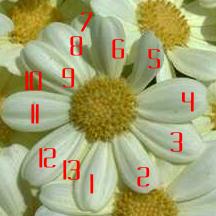
Fibonacci numbers also appear in pinecones. If you look at the bottom of one, you can see swirls. If you count the number of little scales in one swirl, it'll be a Fibonacci number. The same pattern is found in the center of sunflowers.
These are all arithmetic principles, because they have to do with counting. Appearances in structure are considered geometric, and there are several of those as well.