AuroraMon
Solar, Space weather and Aurora monitor
| Solar X-rays in the last 24 hours: |

|
Back to MBKTeam homepage |
| Geomagnetic activity: |

|
Back to Astronomical Society Orion |
 A 3 day plot of 5-minute solar X-ray flux values measured on the GOES 8 and 10 satellites. |
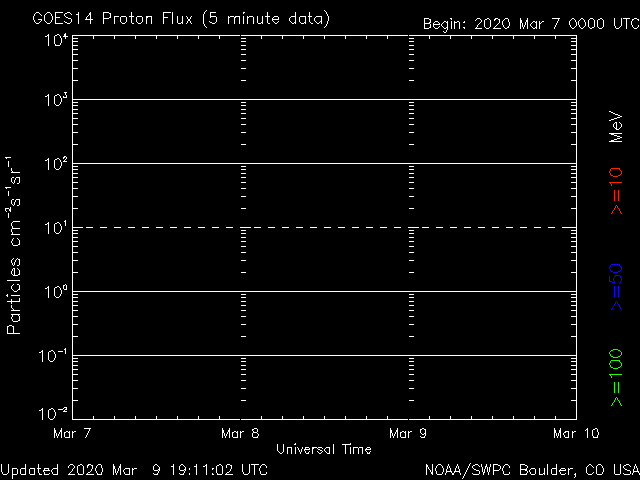 Proton flux as measured by GOES 8 satellite. |
 ACE EPAM electron and proton flux |
 Real time solar wind dials from ACE spacecraft data. When the hand points to red the conditions are favourable for mid latitude aurora. |
 ACE Real-Time Solar Wind 2-hour 6-hour 24-hour 3-day and 7-day ACE RTSW Plots. |
 CELIAS/MTOF Proton Monitor on the SoHO Spacecraft. |
 Other magnetograms (Europe) (North America) |
GOES magnetogram |
 This plot shows the current extent and position of the auroral oval in the northern hemisphere, extrapolated from measurements taken during the most recent polar pass of the NOAA POES satellite. The red arrow in the plot, that looks like a clock hand, points toward the noon meridian. |
 A real-time view of the auroral oval as inferred from the CARISMA magnetometer array. |
 This plot estimates the visibility of aurora from any northern hemisphere locations assuming optimal observing condition. It is updated every 5 minutes. The color of the plot represents the intensity of the aurora, with increasing trend green-brown-red. The locations at the outskirts of the oval are most likely to see auroral activity. The plot is accurate, but one should bear in mind that some locations might see more than others due to auroral substorming. |
 The image above is the most recent VIS image of the northern polar auroral oval, taken by the POLAR spacecraft. Please note: NOAA displays of real-time IMAGE data have ended because useful Auroral images are not available from the spacecraft's current location. |
 The image above is the most recent ultraviolet image of the northern polar auroral oval, taken by the POLAR spacecraft. Lines of latitude and longitude are denoted by the dashed blue lines. Contintental outlines are also shown in green. |
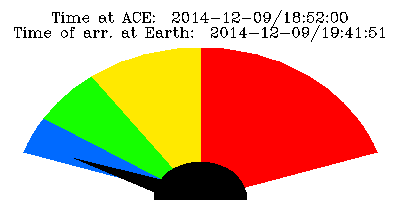 Current Geo-Magnetic Storm Level Based on ACE Real Time Solar Wind Data. Dst values are extrapolated using most recent solar wind and magnetic field data when data gaps are present. Low: Dst > -20 nT Medium: -20 nT > Dst > -50 nT High: -50 nT > Dst > -100 nT Extreme: Dst < -100 nT |
Costello Predicted Activity Index |
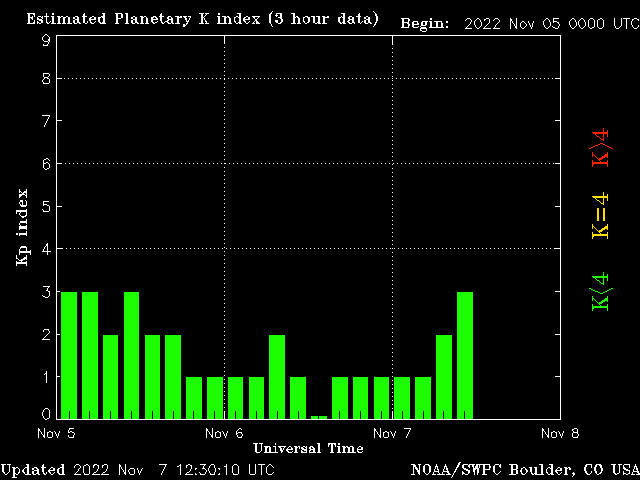 The current Kp-index. A red bar indicates extremely high auroral activity and values over 6 make aurora sightings from middle to low latitudes possible. |
Hourly Dst data (University of Kyoto) Extreme values of Dst < -100 nT make aurora sighting from mid-latitudes possible. |