|
FICTION RECONSTRUCTED EXHIBITION/PERFORMANCE/SYMPOSIUM/SCREENINGS/BOOK/CATALOGUE |
| Curated y Ana Devic and Natasa Ilic. |
|
Škuc Gallery, Ljubljana and Gallery of Contemporary Art Celje in collaboration with Gallery Kapelica, Ljubljana, Gallery Media Nox - MKC Maribor, Slovenian Cinematheque Ljubljana and Maska, Journal for Performing Arts], Ljubljana invite you to take part in the project |
| Project conceived and curated by Marina Gržinić (FI ZRC SAZU), Ljubljana. Devic and Natasa Ilic. |
|
Press Release Ljubljana, December 1, 2000 LJUBLJANA EXHIBITION, PERFORMANCE and LECTURES Skuc Gallery, Stari trg, 21, Ljubljana Thursday, December 7, 2000, at 8.00 p.m. - INAUGURATION OF THE EXHIBITION The exhibition will be on view until January 15, 2001. |
|
In the
80's in Ljubljana several projects based on the idea of reconstruction
of works of art from the avant-garde tradition took place. Projects such
as The Last Futurist Exhibition by
Kasimir Malevich (Belgrade),
The International Exhibition of Modern Art (Armory Show) and the lecture
Walter Benjamin:
Mondrian 1963--1996 were displayed and enacted by the Skuc
Gallery in Ljubljana in 1986. The author of these projects has presented
himself/herself merely through exhibition titles, and often by signing
his/her work with the names of famous and deceased painters and philosophers,
or by using pseudonyms. We can say that this research in contemporary
art is parallel to trends and concepts on a world scale. In the 90's this
same anonymous author opened in a ground-floor apartment in New York's
Soho, the exhibition Salon de Fleurus. Salon de Fleurus is a staged repeat
presentation of one of the most significant collections of modern art
from the turn of this century, which was created by the American author
and literary critic Gertrude Stein
(1874--1946), a Jew of German descent, with the help of her brother Leo
Stein, in their Paris apartment at 27, rue de Fleurus. The collections
of the projects from 1986 presented in Skuc Gallery for the first time
in Slovenia, the lecture and the collection of the New York Salon de Fleurus
will be deconstructed, re-enacted, and simulated again in Ljubljana in
the year 2000. A symposium, video-film screenings and a book/catalogue
are as well part of this complex project of reconstruction and fictionalization.
|
| c. |
|
EXHIBITION:
OBSERVING THE OBSERVED The exhibition is
a joint research project between the anonymous artist and Marina
Grzinic. Marina Grzinic was invited by Skuc Gallery to conceive
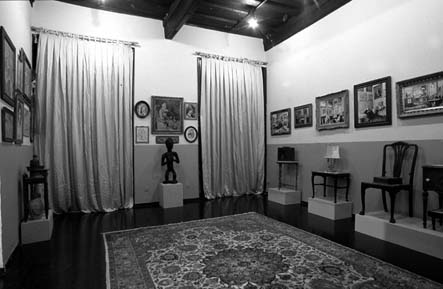
the project. The exhibition consists of artifacts from three contemporary
art collections and of the re-enactment of the lecture from 1986: 1. Art
Collection Salon de Fleurus. Salon de Fleurus opened to the public eight
years ago in a small backyard apartment at 41 Spring Street in New York.
The subject of this long-term project, whose authors remain anonymous,
is the collection of modern art assembled by Leo and Gertrude Stein in
Paris, in their apartment at rue de Fleurus, in the beginning of the 20th
century. Artifacts exhibited in this collection have been an integral
part of the Salon de Fleurus for many years. In Ljubljana, and subsequently
in Celje and Maribor, these artifacts can be seen for the first time outside
of their "natural" context. Meanwhile, in New York, Salon de Fleurus continues
to exist with another set of works, but whose subject remains the same.
2. Art Collection The Last Futurist Exhibition by Kasimir
Malevich (Belgrade) - artifacts from this collection were already
exhibited in Skuc Gallery in Ljubljana, in the spring of 1986]. 3. Art
Collection The International Exhibition of Modern Art (Armory Show) -
artifacts from this collection were already exhibited in Skuc Gallery
in Ljubljana, in the fall of 1986. Walter Benjamin: Mondrian '63 - '96
is the lecture that was given by Walter Benjamin, a German philosopher
who had been dead for almost half a century, while Piet Mondrian, a Dutch
painter and the founder of abstract painting, had died four years after
Benjamin (in 1944)]. An excerpt from the lecture: "The theme of tonight's
lecture is, as was already announced, the work of Piet Mondrian created
between 1963 and 1996, at least as it can be concluded on the basis of
the dates on the paintings themselves. /.../ So, you will ask, 'Why are
so many of Mondrian's paintings gathered in one place in this city?' I
believe that most of you will find it almost incredible. Even if we believed,
just for a moment, that by some miracle it was possible to collect original
Mondrian's just for this occasion, we would soon be confused by the data
found on the paintings themselves. Whoever looks at them closely may notice
that they really have Mondrian's signature, but the dating seems, to say
the very least, rather strange. The paintings are dated with the numbers
63, 79, 83, 86, 92, 96. This means that the earliest was painted in 1963.
And what are we to do? Since we know that Mondrian lived from 1872 to
1944, we can simply conclude that these are not his original paintings.
Even if we suppose that, for some unknown reason, Mondrian was able to
date or anti-date his paintings in this way, a scientific analysis would
soon prove that these paintings were done after his death. Therefore,
we must pose a new question: 'Who is the real creator of these paintings?'"
|
| c. |
|
FICTION
RECONSTRUCTED Copies contain not only all
the parameters of the painting that is being copied, but much more: the
idea itself and the act of copying. Copying makes repetition and reproduction
intrude into the features characteristic of modern art, such as the new,
the original and the authorial; it is not there to falsify and to forge
the original, but to question the current, canonized foundations of modern
art: the identity of the artists and their work, the meaning and significance
of the work, and its interpretation. Questions such as the relation between
the original and the copy, truth and falsehood, sense and non-sense are
legitimate subjects of philosophical discussion. Therefore, the entire
ritual of reconstruction and repetition is not an attempt to falsify,
but rather to analyze the conceptual processes in art and culture. These
are actually anti-historical works. I can therefore, in relation to this
project, re-formulate Dubuffet's notion that "painting can be a machine
communicating philosophy" into "painting can be a machine which already
elaborates philosophy" (H. Damisch). Copies do not originate from an opposition
between works, and do not directly refer to pictorial inventions, but
rather refer to the possibilities of their own appearance. This is a completely
anti-historical reading which does not believe in the disappearance of
things, in linear genealogy, or in a homogenous time without interruptions.
The copy confronts us with forms of historicity and/or anti-historicity
of the visual and virtual /cyber world. (From: Marina Grzinic, Fiction
Reconstructed, Vienna 2000.)
|
| c. |
|
LJUBLJANA
EXHIBITION, PERFORMANCE and LECTURES Skuc
Gallery, Stari trg, 21, Ljubljana Thursday, December 7, 2000, at 8.00
p.m. - INAUGURATION OF THE EXHIBITION The exhibition will be on
view until January 15, 2001.
|
| c. |
|
Skuc
Gallery, Stari trg, 21, Ljubljana Friday, December 8, 2000, at 6.00 p.m.
- a lecture - guidance by Goran
Djordjevic will be held; Djordjevic works as a doorman and care-taker
at the Salon de Fleurus in New York. Friday,
|
| c. |
|
December
8, 2000, at 8.00 p.m. - a re-enactment of the lecture Walter Benjamin:
Mondrian '63 - '96. Walter Benjamin is performed by the Slovenian actor
Jozef Roposa. Skuc Gallery,
Stari trg, 21, Ljubljana Tuesday, December 12, 2000, at 8.00 p.m. - lecture
by Marina Grzinic entitled
Fiction Reconstructed - from The Harbingers of the Apocalypse to the Retro-avant-garde
(1980-2000)
].
|
| c. |
|
CELJE, Slovenia Gallery
of Contemporary Arts: EXHIBITION, PERFORMANCE, LECTURES From February
1 until March 1, 2001. MARIBOR, Slovenia Gallery Media Nox, MKC Maribor:
EXHIBITION, PERFORMANCE, LECTURES From May 8, 2001 until May 19, 2001.
|
| c. |
|
The project was produced by Skuc Gallery, Ljubljana (Gregor Podnar, Josko
Pajer) and Gallery of Contemporary Art Celje. Partners in the project:
- Gallery Kapelica, Ljubljana (Jurij Krpan) - symposium organization -
Maska, Journal for Performing Arts], Ljubljana (Emil Hrvatin) - publisher
of the book-catalogue - MKC, Maribor (Dragica Marinic, Joze Slacek) -
exhibition and book-catalogue - Slovenian Cinematheque, Ljubljana (Koen
van Daele) - video-film programme The project was suported by: ZRC SAZU,
Ljubljana, Director's Fund, dr. Oto Luthar French Institute Charles Nodier,
Ljubljana, dr. Christine Schell KulturKontakt, Avstrija, dr. Annamarie
Türk, dr. Nicole Marjanovic-Zoubek Ministy of Culture of the Republic
of Slovenia City of Ljubljana - cultural department
|
| c. |
|
Sponsored
by GOSTISCE MRAK, Ljubljana. We would like to express our gratitude to:
Moderna galerija Ljubljana and Nives Zalokar, Adele Eisenstein/C3, Aleksandra
Rekar, O & V Art Commerce Ljubljana. INTERNATIONAL SYMPOSIUM WITH VIDEO-FILM
SCREENINGS AND PUBLISHING OF THE BOOK_CATALOGUE FICTION, SPECTRAL HISTORY,
TIME AND THE VIRTUAL: ART, POLITICS, GLOBALIZATION, FEMINISM AND NEW MEDIA
TECHNOLOGIES January 11 and 12, 2001 - Ljubljana Skuc Gallery, Ljubljana,
Gallery Kapelica, Ljubljana, Slovenian Cinematheque, Ljubljana In collaboration
with Slovenian Cinematheque, Ljubljana and Maska, Journal for Performing
Arts, Ljubljana.
|
| c. |
|
The central concept of the international symposium and of the video/film screenings is to share visions on art and media, post-politics, post-modernism, post-socialism and post-theory: to speak about perspectives in contemporary art, politics and new media technologies from artistic, art-historical, philosophical and theoretical points of view. These reflections will be articulated through several spectral figures such as the copy, the icon, the spectral body and the activists' mind, and as well as through globalism, nationalism and transsexual-transfigured frames and positionings. (Marina Grzinic). PARTICIPANTS IN THE SYMPOSIUM AND IN THE BOOK (TO BE PUBLISHED JANUARY 2001) The book/catalogue of the whole project will be published January 2001 as a special number of Maska, Journal for Performing Arts, Ljubljana. In the English-Slovenian book edition texts by known international philosophers, theorists, artists and activists will be published. Goran Djordjevic (Beograd[Belgrade]-Ljubljana-New York); Timothy Druckrey (ZDA/USA); Michael Fehr (Nemcija/Germany); Marina Grzinic (Ljubljana); IRWIN (Ljubljana); Maria Klonaris and Katerina Thomadaki (Francija-Grcija/France-Greece); Lev Manovich (ZDA-Rusija/USA-Russia); Georg Schöllhammer (Avstrija/Austria); Hito Steyerl (Nemcija/Germany); 0100101110101101.ORG. |