|
|
WARMARKT INC., There is no business like
war business!
Show room of WARMARKT INC. open for
clients:
Škuc Gallery, Friday, December 1st
, 8 - 10 pm.
Škuc Gallery, Saturday, December 2nd,
1 - 4 pm
Škuc Gallery, Sunday, December 3rd,
11 am - 3 pm
WARMARKT INC. is an international
investment business group. As world
leaders in the field of war investment
we consult business and private clients
in investment portfolio management.
Visit the WARMARKT INC. show room in
Škuc Gallery and experience the exciting
world of war investment and its
astonishing profits!
www.warmarkt.com
Production: NO HISTORY - Zavod za
sodobne umetnosti, Ljubljana
Coproduction: BALKANET e.V., München
With the help of: Mestna občina
Ljubljana, Ministrstvo za kulturo
Republike Slovenije, Kulturreferat der
Landeshauptstadt
München, Galerija Škuc, Lenovo
Slovenija, Radgonske gorice, Okuspokus
|
 |
MILORAD KRSTIĆ: DAS ANATOMISCHE THEATER
You are kindly invited to
discussion with Milorad Krstić on
Friday, November 10th at 6 pm at
Škuc Gallery.
|
|
|
EAST
ART MAP: Contemporary Art and Eastern
europe
Edited by IRWIN
You are kindly invited to
the presentation of the book
EAST ART MAP:
Contemporary Art and Eastern europe
which is going to to take place at Škuc
Gallery on Thursday,
October 26th at 7 pm.
Speakers: Irwin,
Marina Gržinić and Sergej Kapus.
More information about
East Art Map:
www.eastartmap.org
|
|
|
DISCUSSION WITH REGINE DEBATTY AND PAOLO
PEDERCINI
You are kindly invited to discussion in
the framework of Interactive Festival
with two distinctive representatives of
contemporary digital scene - Regine
Debatty and Paolo Pedercini.
The event will take place at Škuc
Gallery on Wednesday, October 25th
at 8.30 pm.
Speakers: Regine
Debatty, Paolo Pedercini and Vuk
Čosić
Links:
www.we-make-money-not-art.com (Regine
Debatty)
www.molleindustria.com (Paolo
Pedercini)
|
|
|
LOST
HIGHWAY EXPEDITION
– LJUBLJANA > July
30 - 31, 2006
From
30 July to 24
August a massive
movement of
individuals will
take its route
through Ljubljana,
Zagreb, Novi Sad,
Belgrade, Skopje,
Prishtina, Tirana,
Podgorica and
Sarajevo.
Lost
Highway Expedition
[LHE] is a
temporary society
that will as a self-organised
exchange of
knowledge and
resources, navigate
the new and dynamic
territorialities of
the Western Balkans.
While Europe faces
fear of unstable
territories and
uncertain future
Lost Highway
Expedition, an
experimental network
in the making, will
tackle the issue of
which future is the
best.
At
each city along the
route, Lost
Highway Expedition
will interact with
projects and issues
that local
organisations and
groups deem
important for the
future of their own
contexts. Curently
the participating
organizations in
Lost Highway
Expedition are
Galerija Škuc
(Ljubljana), Mama,
Platforma 9,81
(Zagreb), Kuda.org
(Novi Sad), Prelom
kolektiv and SMS (Belgrade),
Missing Identity (Prishtina),
Press to Exit
(Skopje) and Pro.ba
(Sarajevo)which,
however look forward
to extending this
experimental network.
The exact programme
and events will be
determined in
interactive
collaboration
between all
participants and
organisations,
before and during
the expedition.
Lost
Highway Expedition
is the opening event
of Europe Lost
and Found [ELF],
an interdisciplinary
and cross-national
research project
that aims to imagine
economic, political,
and cultural
geographies of a
future Europe.
One
of its outcomes is
the Centrala
Foundation for
Future Cities
and the School of
Missing Studies
was established on
the initiative of
Azra Akšamija,
Katherine Carl, Ana
Džokić, Ivan Kučina,
Marc Neelen, Kyong
Park, Marjetica
Potrč and Srdjan
Jovanović Weiss – a
network of people
which is rapidly
spreading...
www.europelostandfound.net
(Potential partner
projects or fellow
travellers as well
as practical
information about
route of expedition,
historical facts
about the Lost
Highway (Highway
of 'Brotherhood and
Unity') and the
Lost Highway
initiative are
available on this
web site. You can
help develop and
expand the platform
by adding
information on your
projects, contribute
your know-how or
useful information.)
Expedition timeline:
July
30-31 > Ljubljana,
August 2-3 > Zagreb,
August 5-6 > Novi
Sad, August 8-9 >
Belgrade, August
11-12 > Skopje,
August 14-15 >
Pristina, August
17-18 > Tirana,
August 20-21 >
Podgorica, August
23-24 > Sarajevo
The
Ljubljana station:
With the support of
the
Slovenian
Ministry of Foreign
Affairs
the Škuc Gallery
will host the first
stop of the
expedition between
30 and 31 July 2006.
In collaboration
with Marjetica
Potrč we have
drafted a programme
which focuses on
Ljubljana and its
autonomous zones:
BTC
City: 'My City':
A
shopping mall that
aspires to become a
city. BTC City
shopping mall has
developed on the
location of the
vacated warehouses
after they were left
empty due to the
secession of
Slovenia from ex-Yugoslavia.
It is a private
company, which is
currently one of the
biggest shopping
malls in Europe.
Krakovo:
An urban enclave in
the city centre.
Krakovo rural
enclave is located
in the very city
centre. By literary
crossing a street,
you find yourself in
a village, where
agricultural produce
is the main source
of income to its
residents.
AKC
Metelkova City:
A
squat of a city
block becomes space
for cultural
production.
Metelkova City is
located in the city
block that had
housed Ex-Yugoslav
army, which withdrew
in 1991. It was
squatted by artists
and cultural
producers in 1992
after the sudden
decision of
Municipality of
Ljubljana to
demolish buildings
which had been
promised to host
independent culture.
Tovarna Rog:
A
squat of a factory
becomes space for
cultural production.
The most recent
squat in Ljubljana,
Tovarna Rog is an
initiative that
started in March
2006 on the 7000
square metres of the
abandoned bicycle
factory Rog. Tovarna
Rog is organised as
an open structure,
where night and day
space is temporary
used by cultural
producers.
The event will be
accompanied by a
catalogue
entitled Lost
Highway Expedition,
which will be
available at the
Škuc Gallery.
In
2007
the
Škuc Gallery will
host an
exhibition project,
which is only one
link in the chain of
the project
Europe Lost and
Found. More than
one hundred artists,
theoreticians,
curators, architects
and critics, drawn
from all over the
world, will embark
on the journey from
the first
(Ljubljana) to the
last stop
(Sarajevo). Further
selection of artists
will be possible
after the end of the
exhibition.
Exhibited projects
will be based on the
experience and ideas
gained during the
Lost Highway
exhibition.
PROGRAMME
Sunday, July 30th
– Galerija Škuc,
Stari trg 21
10.00
– Meeting point at
Škuc Gallery
12.00
– Short introduction
about Škuc Gallery
by Alenka Gregorič
- Presentation of
the Lost Highway
Reader by Helena
Drnovšek Zorko
13.00
- Presentation of
Ljubljana's
Autonomous Zones:
BTC City, Krakovo,
Tovarna Rog/Rog
Factory, AKC
Metelkova City, by
Marjetica Potrč
14.00
and 15.00 - A walk
through Krakovo to
the nearby Plečnik's
house(Plečnik's
Collection) – Guided
tour in English
language (in 2
groups)
17.00
– Presentation of
the »Brotherhood and
Unity« project (currently
presented in
Simulaker Gallery in
Novo Mesto) and
video screening ("Brotherhood
and Unity") by
artist Marija Mojca
Pungerčar and
curator of the show
Iztok Hotko
18.00
– Screening of the
video about Rog
Factory
19.00
– 21.00 – Off
programme (possibility
to show the works of
the LHE participants)
20.00
– Screening of film
by Oliver Ressler &
Dario Azzellini – »5
Factories – Worker
Control Venezuela«
Monday, July 31st
11.00
– BTC City
Sightseeing
12.00 - BTC City
presentation (history
and future
development), by BTC
City representative
18.00
– Meeting point in
Tovarna Rog ,
presentation by Saša
Spačal and screening
of the video about
Rog Factory
20.00
– Meeting point at
AKC Metelkova –
Menza pri koritu
Guiding tour and
presentation by
Jadranka Ljubičič
|
|
|
|
|
A
Planning Summit for Lost Highway
Expedition
May 30th – 31st, 2006
Hosted by Moderna
galerija, Ljubljana and Galerija
Škuc, Ljubljana
Funded
by Slovenian Ministry of Foreign Affairs,
Trust for Mutual Understanding
Lost Highway Expeditions
[LHE] is a planned massive movement of
individuals that will plot a route
through Ljubljana, Zagreb, Novi Sad,
Belgrade, Skopje, Prishtina, Tirana,
Podgorica and Sarajevo from July 30 to
August 24, 2006. For individual
presentations and collective dialogues
on the concept and possible programs for
the expedition, representatives from
participating organizations of Lost
Highway Expedition will gather in
Ljubljana for a two-day long summit. To
date, participating organizations in
Lost Highway Expedition are Galerija
Škuc (Ljubljana), Tovarna Rog
(Ljubljana), Platforma 9,81 (Zagreb),
Kuda (Novi Sad), Prelom kolektiv and SMS
(Belgrade), Press to Exit (Skopje), Exit
ICA Gallery (Prishtina), PROJEKTOR (Podgorica)
and Pro.ba (Sarajevo). Representatives
from participating exhibition spaces
joining the conference are Moderna
galerija (Ljubljana), Galerija Škuc
(Ljubljana) and Württembergischer
Kunstverein (Stuttgart), as well as key
members of Centrala Foundation for
Future Cities (Rotterdam) and School of
Missing Studies (Belgrade/New York/Rotterdam).
As a self-organized
exchange of knowledge and resources,
Lost Highway Expedition [LHE] is a
temporary society that will navigate the
new and dynamic territorialities of the
Western Balkans. At each city along the
route, Lost Highway Expedition will
interact with projects and issues that
local organizations and groups find
important for the future of their own
contexts. The exact programs and events
will emerge from the interactive
collaborations between all participants
and organizations, before and during the
expedition. The project does not have
pre-determined goals and will be guided
by the self-generating actions of the
expedition itself. However, the
following questions can be the starting
points for further explorations.
How can BORDERS [political
and cultural] become a creative space in
which differences are both fundamental
and irrelevant?
Will the future SOCIETY
continues to be ruled by a vertical
[central] AUTHORITY or by horizontal [network]
INITIATIVEs?
What future spatial
instruments are emerging from the new
architectural and urban LANDSCAPES of
the Western Balkans?
How can the assumed
dichotomy between NOMADIC and SEDENTARY
societies become a constructive parallax?
What is the Western
Balkan and what is Europe, or do they
even EXIST?
Because LHE is a
fragmented, non-hierarchical, center-less,
informal, bottom-up, self-generating,
de-centralized, network-based open-source
society, you can invite other people,
groups, or organizations to join in.
Everyone is expected to self-organize,
support, and realize their journey. You
do not have to travel or stay together,
and you can enter and exit the
expedition for any length of time and at
any point. You are free to veer away
from the planned route, and to explore
and collaborate with other cities, towns
and regions that are between the nine
cities.
From the invitation to participate in
the LHE
Lost Highway Expedition [LHE]
is the opening event of Europe Lost and
Found [ELF], an interdisciplinary and
cross-national research project that
likes to imagine economic, political,
and cultural geographies for a future
Europe. It will unfold with mass
expeditions, first across the Western
Balkans, then through continental and
Mediterranean Europe, in order to make a
comparative exploration of Europe’s
cultures and ethnicities, its hybrid
landscapes and parallel economies.
Through analysis and visual
documentation of urban and cultural
landscapes, dynamic and SMS-based
mappings, interdisciplinary research
projects, discussion forums, a pan-European
cultural contest, as well as independent
studies, the project will seek
innovative phenomena and positive signs
of co-existence for the future.
www.europelostandfound.net
PROGRAMME
The conference will be held in English
language.
Tuesday, May 30th, 2006
Location:
Moderna galerija, Tomšičeva 14 and
Tovarna Rog, Trubarjeva 72
10:00 Welcome by Zdenka
Badovinac [director of Moderna
galerija—Ljubljana
10:10 An Introduction by
Helena Drnovšek Zorko [Slovenian
Ministry of Foreign Affairs-Ljubljana]
10:20 How the project
began by Marjetica Potrč [Centrala -
Ljubljana] and Kyong Park[Centrala – New
York/Berlin]
10:30 Azra Aksamija
[Centrala—Boston/Sarajevo] and Ivan
Kučina
[Centrala + SMS—Belgrade]
10:40 Ana Džokić
[Centrala + SMS—Rotterdam/Belgrade] and
Srdjan Jovanović Weiss [Centrala + SMS—New
York/Belgrade]
10:50 Katherine Carl
[Centrala + SMS—New York/Belgrade] and
Marc Neelen
[Centrala + SMS—Rotterdam]
11:00 - 11:30
Dialogue + Break
11:30 Asja
Hafner [Pro.ba —Sarajevo]
11:45 Srdjan Jovanović
Weiss [Kuda—Novi Sad]
12:00 Erzen Shkololli [EXIT
ICA Gallery—Prishtina]
12:15 - 12:45
Dialogue
15:00 Marko Sančanin
[Platforma 9.81—Zagreb]
15:15 Dušan Grlja [Prelom
kolektiv—Belgrade]
15:30 Jane Calovski [Press
to Exit—Skopje]
15:45 - 16:15
Dialogue + Break
16:15 Borislav Vukičević
[PROJEKTOR—Podgorica]
16:30 Stefano Romano—not
present, only his presentation [1.60
insurgent space —Tirana]
17:30 Meeting with TEMP
group in Tovarna Rog, Trubarjeva 72,
Ljubljana
Guiding tour,
presentation and dialogue
19:30
Improvised dinner at Tovarna
Rog
|
|
|
 |
|
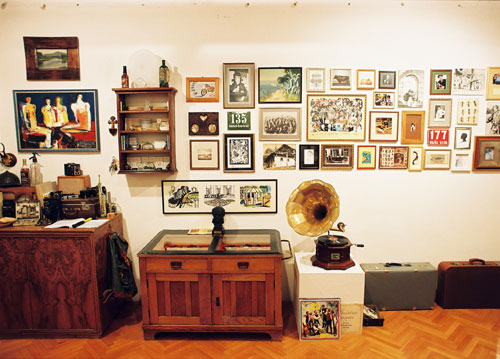
Domestic Research
Society presents:
Folk Museum of
Nani Poljanec
Cabinet (courtyard of
Škuc Gallery), Stari trg 21, Ljubljana
11 — 25 May 2006
Domestic Research Society records,
collects, researches and presents
domestic phenomena. In 2005 we made The
Cabinet, a modular display laboratory,
which echoes the cabinet of curiosities.
The Cabinet presents productions of
society's members, as well as collectors
and their curious private collections.
We are interested in personal
mythologies, interpretations and systems
of belief, which the collectors draw
from their collections.
The first exhibition of
a private collection in the Cabinet
presents Folk Museum of Nani
Poljanec.
Nani Poljanec
comes from Rogaška Slatina. He
is a photographer, poet, actor,
collector of antiques, chef, fashion
designer, cultural event manager,
journalist, 'ethno pomp artist', and a
self-proclaimed 'folk creator'.
The public knows him from the Hri-bar TV
show, where he plays Don Corleone.
Poljanec has carried out several
acclaimed public actions. In the 'Christ
at Thirty-Three' project he hung from a
helicopter, tied with a rope, and then
descended on Mount Boč from the skies.
As Tito the Headbanger among his
pioneers he accepted the baton in the
Relay of Youth on 25 May and visited
Tito's home town of Kumrovec. As a
zealous advocate of folk traditions he
has, among other things, organised
traditional Slovenian folk festivities
of slaughtering a pig with the former
culture minister and with the blessing
of the Ministry of Culture.
Nani Poljanec does not
think of himself as an artist. He sees
his projects as exams, which are part of
his 'postgraduatish' studies at a public
university, the university of his life's
work. He will finish his 'folk creation'
in 2069, when he, as a 101-year-old,
intends to end his life and become a
doctor of folk creativity.
The Folk Museum of Nani Poljanec is in a
way a psycho-social portrait of the
author, which presents his passions, his
history, life, and creative work. It is
a special place located at the Poljanec
home in Rogaška Slatina, and full of
nostalgia. It is there that Nani often
goes to find peace and inspiration. He
has established a museum in honour of
himself and all people who are a part of
his life.
The collection comprises thirty-six
smaller individual collections,
including the Vali monkey stickers,
celebrity autographs, ancient laminated
photographs, tin boxes for biscuits,
radio receivers, installations,
paintings and objects from his folk
performances, and a curious collection
of hair kept for the time, when people
will be cloned from a hair cell. His
current passion is collecting old
watches.
Also part of collection
are individual interesting items such as
official certificate commemorating the
first ever train journey from Belgrade
to Bar signed by Tito, Jovanka, and
others; Nani's death mask for 2069, an
old watch which has 1052 stakeholders, a
bell jar with Nani's soul and his
collection of poems, published in two
copies (one kept by the library and the
other by the author).
Nani Poljanec will set
up his Folk Museum in the Cabinet
premises as he sees fit. The
surroundings, music, and presence of the
author in the museum together are bound
to create a comprehensive work of art,
which the author has fostered all his
life.
The opening of
the Folk Museum of Nani Poljanec will
take place in the Cabinet of Domestic
Research Society on 11 May 2006 at 6 pm.
Buffet with delicacies from the
Obsotelje region, 'jerpice', pumpkin oil
and 'Corleone Brajdovec' will be served.
The
exhibition is curated by Jani Pirnat.
More information on the project
available at
http://www.ddr.si.
The premises of the
Cabinet of Domestic Research Society are
in the abandoned courtyard behind the
Škuc Gallery Stari trg 21 in Ljubljana.
You can visit the Cabinet every day from
11 to 25 May between 4 and 7 pm or by
appointment. Please call +386 (0)1 251
65 40 or +386 (0)41 922 782, or e-mail
to info@ddr.si.
We look forward to
seeing you at the exhibition.
Ljubljana, 8 May
2006 Domestic Research Society
|
|
|
|
|

www.kracina.com/koralniotok
Project author: DAMIJAN KRACINA
Collaborators: Katarina Toman Kracina (painting,
modelling), Ajda Toman (animation), Urška
Boljkovac (photography)
WORKSHOP: March 27 - April 14, 2006
EXHIBITION: May 15 - 16, Škuc Gallery (opening on May 14th
at 6 pm)
May 16 - 27, Clinical Centre Ljubljana
For
many years French NGO Art dans la Cité
(founded in 1996) organizes artistic workshops in hospitals
of Europe. By the project this year also collaborate Škuc
Gallery and Pediatrical Clinic of clinical Centre in
Ljubljana. Damijan Kracina, selected artist and his
collaborators will together with hospitalized children going
to create a project called Coral Rief.
Project
organization: Art dans la Cité,
Škuc Gallery, Pediatrical Clinic of Clinical Centre in
Ljubljana
Project funded by: Culture 2000, French Institute Charles
Nodier, Krka d.d.,
ART, Ljubljana d.o.o.
|
|
|
|
|

|
|
Sigmund Freud's Day in Ljubljana

City of Women presents:
Constanze Ruhm
(Austria)
Ljubljana, 20th of March 2006
Škuc Gallery, Stari trg 21, Ljubljana
14.00 - 18.00 – X Characters / RE(hers)AL
Video installation (72', video loop)
German, English subtitles
18.00 – X Characters: Shifting Identities
llustrated lecture and discussion (with Marina
Gržinić) – in English
The work of Constanze Ruhm focuses on
contemporary forms of an art practice established around the
relation of cinema and new media with an emphasis on notions
of identity, representation and (feminist) film theory.
Productions including and intersecting the fields of
installation, film/video, text/publications, curatorial
projects and websites. Furthermore, the projects include
works in public spaces (the most recent one an invitation
for the competition in the framework of a redesign of a
section of Vienna's Karlsplatz subway passage).
http://www.constanzeruhm.net/portfolio/projects.phtml
Organization: City of Women Association
In collaboration with: Škuc Gallery
With the support of: Austrian Cultural Forum
For
more information visit
http://www.cityofwomen.org/2005/en
|
|
|
|
|
EVENTS
IN THE FRAMEWORK OF EXHIBITION
POGOVARJANJA / CONVERSATIONS / CONVERSAS
Sunday,
March 19th at 6 pm, Škuc Gallery
Presentation of interventions to public space, carried out
by PPP and KUD HUPA
Round table:
TEMPORARY USE IN OLD CENTRE OF LJUBLJANA - potencials and
possibilities
March 8 at 8 pm, Škuc Gallery
Discussion on real estate logic of old centre,
possibilities of revitalization of empty places through
temporary use and City Council opinion about local problems
of city centre.
Concert TIGROVA MAST
(Zagreb)
March 4 at 8 pm, Škuc Gallery
|
WORKSHOP - COMICS AND
GRAFITTI (KOMIKAZE, Zagreb)
Coordinator: Ivana Armanini
March 3 - 5, from 12 noon to 8 pm, Škuc Gallery
Open meeting on "Empty
places in the old centre of Ljubljana" (+ walking)
February 28 at 6 pm, Škuc Gallery
VIDEO DOCUMENT 20I
February 23 at 7 pm, Škuc Gallery
Group Trie (Metod Blejec, Stas Kleindienst, Sebastjan Leban)
Through the field of art the group is trying to set out, to
warn and to explore specific systems within modern society.
DISCUSSION ?artivism = art+activism?
February 22 at 8 pm, Škuc Gallery
When and
how activism enters into the field of art?
When and how artistic actions declare as activistic?
When, why and for who are actions arising? Who, what and why
is creating? How this practices manifestate in social
environment?
How can art avoid social determination of spaces earmarked
for art? How can art establish hybrid interspace of
interdisciplinary and thus avoid principal division of
social spaces? Artivism - new canon in art?
REVOLTS
IN LATIN AMERICA in organization of ČKZ and Dost je!
February 20, Škuc Gallery
11 am:
Press conference by the new release of ČKZ (Magazine for
critic of science)
4 pm: Projection of documentaries, music, latino refreshment
room
WORKSHOP OF STREET TV, NET STREAMING AND VIDEOLIVE EDITING
Collective Insu TV (Naples) – pirat
television, video montage
February 17 - 19, Škuc Gallery, from 12 noon to 8 pm
INSU TV: TVSTREET
www.insutv.it
To support tvstreet project means to suport freedom of
information.
Insu^tv
is a group of activists from Naples. In 2004 they started to
explore audiovisual media which finance themseves. Insu^tv
grew as a public iniciative through various debates,
festivals, exhibitions and concerts with the aim to inform
publicly and independently. In the last years they also
developed service of cheap audio-video equipment and started
promoting the use of low-tech equipment.
|
 |
|
|
|
|
|
|
 |
|
|
|
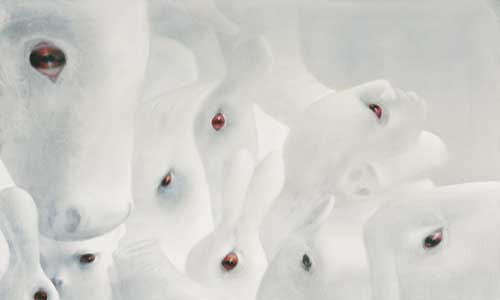
MARKO JAKŠE
Presentation of the Catalogue
Bela čreda 1998 Bela jata 2003
Škuc Gallery,
Friday, February 2nd, 2006 at 7 pm
|
|
|
|
|
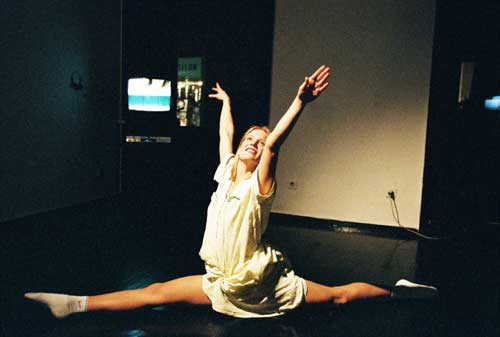 |
Mare Bulc
STUDY
FOR THE LAST EGOISTIC PERFORMANCE
Theatre Exhibition
Sunday, December
18th &
Monday, December 19th 2005
Škuc Gallery, Ljubljana
From 6 to 10
pm
Free Admission.
Exhibitors:
Alja Kapun,
Medeja Novak, Ana Hribar, Miha Brajnik Damir Leventić
and Nejc Saje
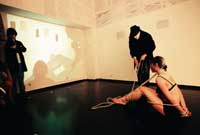
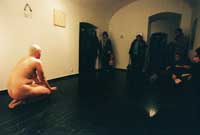
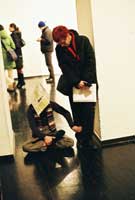
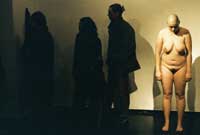
Study
for the last egoistic performance
is an
exhibition for four actors, a scenographer, and a video
artist. Exhibitors exhibit different reinterpretations of
the four performances from Mare Bulc’s No History / Know
History series. The viewers can enter and exit the
exhibition space freely.
Study for the last egoistic performance
is the next-to-last event in the four year
research project No History / Know History that Mare Bulc is
working on as a side project to his study of theatre
directing at the Ljubljana Academy of Theatre, Radio, Film
and Television (AGRFT). The author examines the areas and
strategies on the borderline between performance art and
theatre, as well as the system, history and authorship of
art. The project is a polygon on which the author
contemplates contemporary theatre and confronts it with the
classical drama theatre as taught at AGRFT.
Mare
Bulc
is a theatre director, performer and multimedia artist from
Ljubljana. He studied communication studies at Faculty of
Social Sciences in Ljubljana and is finishing his theatre
directing studies at AGRFT in Ljubljana. In 1994 he
cofounded Dejmo stisnt theatre in Vrhnika, and founded No
History – institute for contemporary arts ten years later.
He has been a member of international SilentCell Network
platform for several years. He is also cofounder of the P.E.A.C.E.
organization and coauthor of Cream of Contemporary Slovenian
Art project. The last three years he has been working on the
four-year research No History / Know History project.
Produced
by: E.P.I. Center
Coproduced by: No History
We would like to thank:
Bojana Kunst, Maks Soršak, Branko Potočan, Martina Kokovnik,
Jure Novak and Mare Bulc.
|
|
 |
 |
|
|
|
 |
 |
|
|
|