Cinema Solution
Four models representing my own intimate imagination of different historical
types of cinema.
The models were a part of the Movie Tales exhibition which took place
in Škuc Gallery, Ljubljana in February 2001. (T.P.)
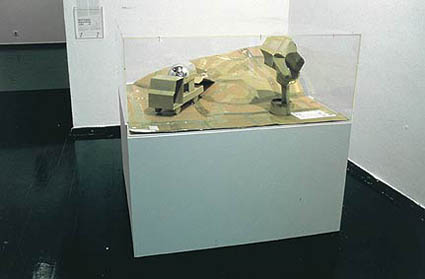
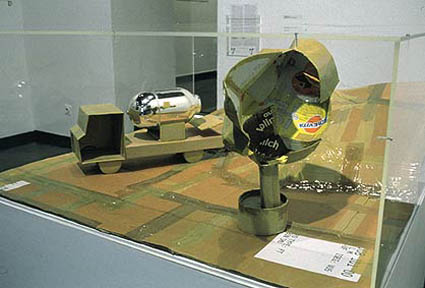
Lost Cinema
Cardboard, tape, glass, plexiglass, wood, 100 x 90 x 120 cm, 2001
Lost Cinema
- the model and accompanying text wish to expose the problem concerning
the stand taken by Bauhaus. Most of all it questions the Gropius intention
to link art to the big industrial capital. The link actually took place
after WW II with American corporative sponsorship.
The stand can be understood as the first step into the era of conglomerate
of megamuseum and multiplex, into the era in which art is considered to
be part of entertainment industry. (T.P.)
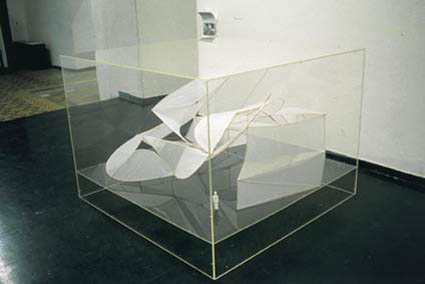
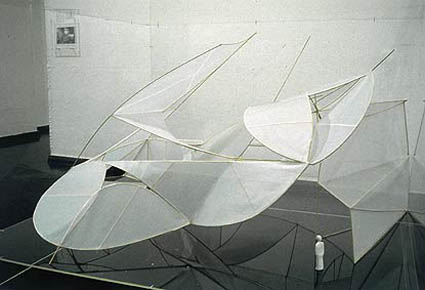
Deconstructed Cinema, paper, wood, tape, plexiglass, 155 x 150
x 110 cm, 2001
Deconstructed Cinema - Kiesler’s idea of a 100% cinema
was realised in 1928 at Film Guild Theatre in New York. The idea was practised
to the greatest extent in the American second-run and socialist village
theatres. The decline of this concept in the 1970s marks another key moment
in the process of transformation of the classical cinema. This moment
of decline is also the main idea of the model - transformation and destruction
of the screen and the way it is observed. (T.P.)
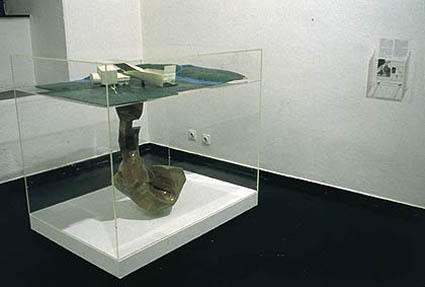
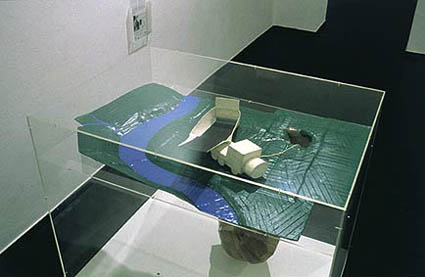
Underground Cinema
Cardboard, tape, plexiglass, wood, 70 x 100 x 115 cm, 2001
Underground Cinema
- How the decline of the golden era of the classical cinema could be perceived
today? The decline took place somewhere in the 1960s and the field of
art it is represented in a unique way in an unrealised project “Underground
Cinema” by Robert Smithson. The question would be as follows: what happens
after the cinema is moved underground, what kind of transformation takes
place? (T.P.)
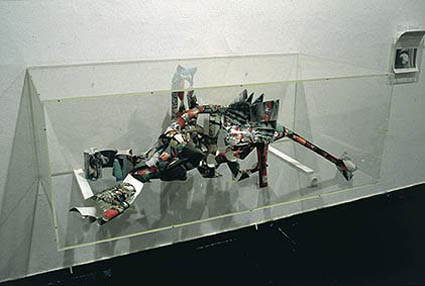
Cinema Cinema Dream
Colour prints, clamps, plexiglass, 140 x 50 x 60 cm, 2001
Cinema Cinema Dream
- I wanted to bring attention to the Chris Marker’s creative statement
which seems paradigmatic for the transition from the celluloid to the
electronic media. In the idea for the model I tried to unite both of his
conceptual extremes which are: on one hand the transforming the still
image into a intimate story (La Jetee, 1963) and on the second hand the
moment which takes place in the field of electronic media where we observe
the individual’s intimacy amalgamating into collective dream (see Marker’s
web site).
In this case, the object is just a model of the space impossible to exist,
of a theatre which can no longer exist as such. (T.P.)
go back