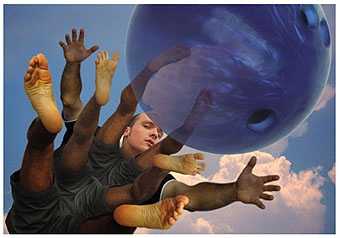
July 10 - August 20 2003 This exhibition explores narrative viewpoints of misunderstanding and conflicting situations using digital photomontage and video installation. The scenes, recycled and imagined, are based on personal reflection and references taken from the history of art, and have been produced as advertising notice boards - billboards and projections. The billboard, the ultimate urban simulacrum, which presents itself locally as a visualisation of a second wave of transitional fetishistic consumerism, in artistic use namely represents a continuation of the tradition of avant-garde techniques of visual communication of the 20s, like photo and film montage, collage, surrealism, the use of sexual attraction in advertising, modern graphic design and new typography. The gallery installation problematizes the billboard medium and emphasises its sacred status in contemporary society. The billboard is the concentrate of the advertising spot, the draft of the key sequence, and the point of departure for the whole story. Like icons and frescoes, so with video and film, the billboard is bound to the saturation of images, the intertwining of the artistic and the commercial, the avant-garde and kitsch, a direct address to the viewer and an emotive obligation of the masses. Vipotnik's photographic enlargements for billboards are structured like film images and placed in an ambient way, in the tradition of spatial painting and in the context of a closed, more protracted contemplative relationship. This contradiction opens up the question of the visitor's attention and the time granted to contemporary installations, which we have become accustomed to consuming in such a way that the term interpassive emerges: for an instant, we look with a fleeting glance before moving on, like with the billboards along the roadside. Like the billboards along the roadside, which catch the driver's attention redirecting it from real onto imaginary roads, the audiovisual gallery installation turns into the side roads wishing for the narrative to meet its tale and function as a political action. The personal tale is opened up by the narrative in a specific moment in the history of culture and it is socially symbolic. The individual is the property of his time; it is difficult to say where we end, where the world begins beyond us. It is impossible to define the edge of physical space. These margins are drawn with experience, or with the narrative of the life story - like life itself, narration is also subject to change. We organise our time and space, and the means of communicating by using mobile phones and Internet connections; we are getting used to corporate systems of communication and server firms that dictate the duration and the structure of communication. The exhibition treats narrative as a useful category, which is in different contexts incessantly forming and reforming itself. Or as Vipotnik says, "the story is never one and only. Moreover, there are more stories, which run in parallel. They intertwine with one another and complete each other."
Mercury Falling is a second exhibition
project in the framework of Škuc Gallery's Local talk programme,
which presents projects curated by guest curators. Production crew: photography by Martin Bebler, Nino Rakičević,
Tilen Vipotnik The project was supported by:
Special thanks: Jure Robinik, dr. Bojan Sedmak, dr. Jasna Štrus, dr. Rok Kostanjšek, mag. Nada Žnidaršič, Luka Malenšek, Darko Bevc, Mojca Hruševar Rakušček, Dada Bac, Zoran Ivkovič, Nano Vipotnik, Manca Percl, Miha Knific, Lisa Parks, Gregor Podnar, Moderna galerija Ljubljana
|