
Paper with this title was published in the slovenian journal Muzikološki zbornik 33 (1997): 5-21, Ljubljana, Slovenia
The Summary of the paper is available here.
There are many examples of animal sounds or vibration signals mentioned in this paper and presented in the form of oscillograms and sonograms. To get a better idea about these communication we present here the following examples of the animal sound and vibration signals.
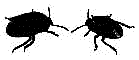
Vibrational signals and songs are produced by many insects, among most interesting ones are produced by small bugs (Heteroptera) of the family Cydnidae. The signals are produced by two different mechanisms, a stridulation and by a body pendular vibration or a simple tymbal mechanism. For their communication only the substrate vibration or tremulation and not the airborne sound is crucial.
Our example will be the bug from the family Cydnidae, Tritomegas bicolor
info and
photos-2
By stridulation it produces short irregularly repeated signals, when touched, attacked or disturbed in another way. The signal is called disturbance call - sound sample:

More interesting are the vibrational songs during courtship and mating. Males produce first courtship song (MS-2) with repeated phrases composed by low frequency part followed by stridulatory chirps. After some time the male switches to the intense second courtship song (MS-3). If the female is receptive, it responses with prolonged high pitched stridulatory chirping (FS-2). These signals can be heard as a whole sequence MS2-FS2-MS3:
and seen separately in the following three oscillograms:
MS-2

FS-2

and MS-3:

Among the courting males comes often to the rival alternation:
MS-R:

 with
the male's courtship vibrational song
strongly reminding the drumming solo of a jazz musician:
We present here three drumming sequences of the same animal in a musical transcript (courtesy of B. Perovšek):
with
the male's courtship vibrational song
strongly reminding the drumming solo of a jazz musician:
We present here three drumming sequences of the same animal in a musical transcript (courtesy of B. Perovšek):


It has many vibrational songs and one of them is used in alternation between males, females or even youngs. Let's hear two alternating animals:
These bugs answer with such vibration signals also to various sounds and even to human speech or whistle and mimic the duration of such sounds. One can listen to such alternation between a bug (Ph) and an experimentor (H):
and see the sonagram below: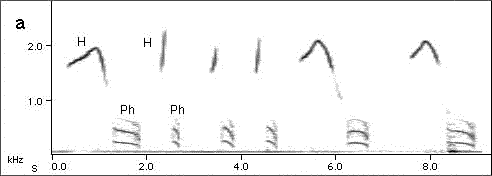
In contrast to European cicadas there
some species sing like birds with high
degreee of frequency modulation. Let's hear as an example the song of Platylomia spinosa:
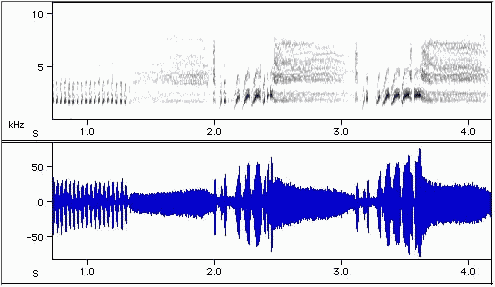
A number of singing cicadas is in many sites so high that they have to share time of singing with other species in a certain order to enable efficient communication. Therefore the sounds in the rainforest change from hour to hour as can be shown in the next examples from the Belum Forest, Malaysia.
Early in the morning we can hear so called "Beethoven bird" with the well known tune, then an unidentified cicada with the nickname "morning fanfare", and at the end another cicada from the genus Purana
Later before noon we hear hornbill calls flying to the feeding site, then the loud song of Purana depictaand at the end the gentle song of the beautiful cicada Terengganua sibylla
Around 5pm afternoon the green cicadas Dundubia vaginata are calling, later we hear calls of various birds, wave sounds on the lake and finally the "fireman cicadas"
In the evening around 7pm the biggest cicadas of the genus Pomponia begin to call together with some other species, the we can hear forest geckos, another unidentified cicada "donkey" or the "water pump" and finally a night chorus of crickets, frogs and other night animals
At night we hear calls of Argus pheasant, night chorus of various insects and frogs and at midnight the "Midnight cicada", also belonging to the genus Megapomponia
More examples on songs of tropical cicadas can be heard in the homepage about Asian_cicadas.
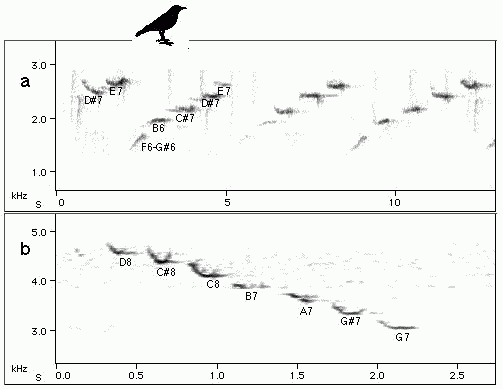
Surprizing are also songs of many tropical birds, some of them are singing in major or minor - scales up, like Myiophoneus caeruleus (a)
or down (b) like some other birds - see below!
One of the most complicated and phantastically coordinated sound emission which I heard and recorded in the National Park of Taleban (Thailand) was the singing of two gibons in polyphony. Lets hear a short sequence of such glissando:
shown also in the graph below.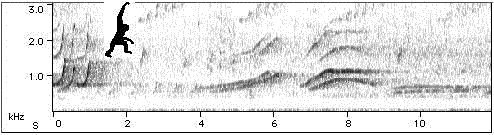
The author, biologist with some musical education and experience is working in the field of bioacoustics for more than 40 years. He wants to show on the examples from his investigations, mainly on insects but also on some other animals, properties of the animal sounds, interesting also from the musical point of view. Presented is the vast diversity of acoustic signals, variability of animal songs, and presence of some musical elements in these samples. One can find in animal songs complicated patterns and rhythms, regular alternation, imitation of other sounds, singing in tonal modes, singing in harmony with another conspecific animal or animals and even a kind of dancing in the rhythm of its own song.
Most examples presented in the first part of this paper are from vibrational songs of European species of bugs (Insecta: Heteroptera) and in the second part from animals (cicadas, birds and mammals) recorded in the tropics. The biodiversity of tropical rain forests is mirrored in the richness of soundscapes, especially in S.E. Asia. The author was during his expeditions especially impressed by acoustic diversity of tropical cicadas, characterized by for insects unusual high degree of frequency modulation and with many species strictly singing only during specific short time window during the day or the night. There are also birds, singing in scales up and down, and gibbons, singing in polyphony. The whole soundscape of undisturbed tropical rain forest is a never ending symphony of nature, changing from hour to hour, with the climax at dawn.
Recently many musicassettes and CD-s are produced with recordings
of soundscapes or selected animal sounds with the aim to substitute
natural events, for meditation, as interesting acoustic background,
or for scientific purposes. Some composers use recordings of animal
sounds as sources of new ideas or even as material for bioacoustic
compositions*). Digitized sound samples used for this
paper are available here on Internet. But one should prefer listening
to the real sounds in nature...
*) As an example one can listen to such "bioacoustic composition" Touchings - Dotiki:
Fanfares
Temengor
Tigerhide

Last update: 13.12.2017
 Matija
Gogala
Matija
Gogala