|
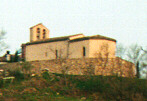 |
The oldest preserved monument in Ustje is the church of St. John at the top of the hill. The portal at the entrance carries the date 1618 engraved in stone. The position and architecture of the church and the walls prove that this very place probably stood as a watch tower with a camp at the time of Turkish invasion. |
During the period of the Austria-Hungarian
Monarchy the village flourished
up to the year 1914 when the "Great War" began. Men of all ages had to
leave their homes and several lost their lives for the Emperor in the
trenches
of the far-away Russia and Carpathian Mountains. In 1915 "steel arms
began
their bitter battle" as the poet Gregorcic wrote, very close to Ustje
on
the river Soca.
The villagers found themselves in the frightening frontline hinterland.
After the downfall of the
Austria-Hungarian Monarchy the Italians gained
supremacy over these parts. The progress of the Italian fascism brought
people two dark decades and eventually the second "Great War".
 The
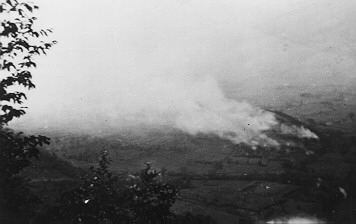
darkest chapter in the history of Ustje is undoubtedly August 8, 1942.
The
darkest chapter in the history of Ustje is undoubtedly August 8, 1942.
At that time there were soldiers of the Italian Alpine Division Giulia
placed in the barracks of Ajdovscina. The commander of the carabineers
(the Italian police) in Ajdovscina was Cir Pasquale Marone, undoubtedly
an Italian. By many he was respected as an honest man. Responding to
complaints
of the local people he persecuted his own fellow-countrymen, above all
the soldiers of the Alpine Division Giulia, who looted in the villages
and troubled people. He supposedly even slapped a non-commissioned
officer.
That is why his soldiers plotted against their carabineer college. In
the
night from 7th to 8th
August 1942 they enticed him
to Ustje under false pretenses that there were partisans in that
village.
There they themselves shot him from an ambush and put the guilt on the
villagers. Ustje awoke that morning to find the village encircled by
Italian
soldiers and hardly anyone could forebode what the day would bring.
People
were driven from their homes to the small square in front of the church
where machine guns were waiting for them. They put all male inhabitants
along the churchyard walls with the intent of killing them. The worst
that
could happen was prevented by the intervention of the mayor of
Ajdovscina
and the owner of a sow-mill (the present factory LIPA in Ajdovscina),
Rizzato.
Nevertheless, eight people were killed and all male villagers were
taken
to the prisons of Gorizia where they spent 40 days in uncertainty. The
women and children were confined to the Ajdovscina school, but they
were
released the next day. The village was completely burnt down, with the
exception of the church, the school and a few houses. Danilo Lokar, a
writer
from Ajdovscina, described this sad event in his book: "The Doomsday in
the Village".
The difficult postwar years followed. This
was a period of great poverty,
renovation of houses and not at last the disappointment with the
heartily
expected "freedom", which became an empty promise and brought back
words
to people, but stole their thoughts.
The villagers returned to cultivating their fields and vineyards again,
mowing their meadows and built a new Ustje.
 |
|
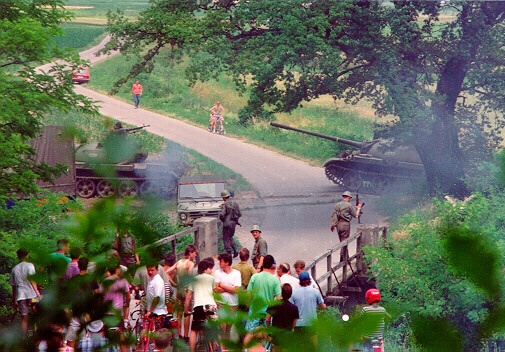
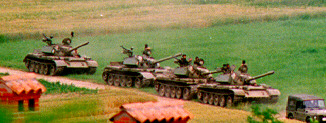
Those days the Yugoslav Army tanks roared along the
fields by the village
continuing their inglorious advance to Rozna Dolina and other
border-crossings
near Gorizia. The inhabitants of Ustje "bid them welcome" on the bridge
by the old village oak-tree, not far from the spot, where the
carabineers'
commander Marone was killed on August 8, 1942...