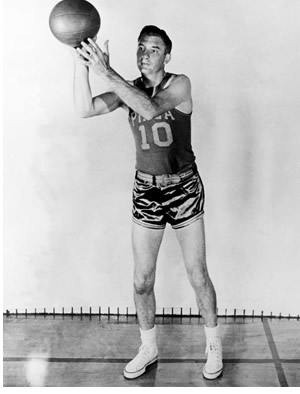
The Warriors were founded in 1946 as the Philadelphia Warriors, a charter member of the Basketball Association of America. They were owned by Peter A. Tyrrell, who also owned the Philadelphia Rockets of the American Hockey League.[10] Tyrrell hired Eddie Gottlieb, a longtime basketball promoter in the Philadelphia area, as coach and general manager.[11] The owners named the team after the Philadelphia Warriors, an old basketball team who played in the American Basketball League in 1925.[12]
The Warriors won its other championship in Philadelphia in the
1955–56 season, defeating the
Fort Wayne Pistons four games to one. The Warrior stars of this era were
future Hall of Famers
Paul
Arizin,
Tom Gola and
Neil
Johnston. In 1959, the team signed draft pick
Wilt Chamberlain. Known as "Wilt the Stilt", he led the team in scoring six
times, quickly began shattering NBA scoring records and changed the NBA style of
play forever. On March 2, 1962, in a Warrior "home" game played on a
neutral court in
Hershey, Pennsylvania, Chamberlain
scored 100 points against the
New York Knicks, a single-game record the NBA ranks among its finest
moments.[13]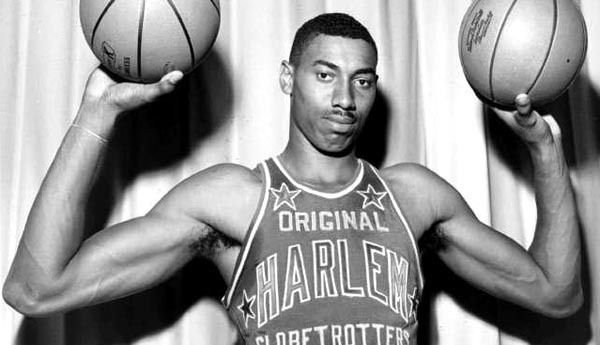
In 1962, Franklin Mieuli purchased the majority shares of the team and relocated the franchise to the San Francisco Bay Area, renaming them the San Francisco Warriors. The Warriors played most of their home games at the Cow Palace in Daly City (the facility lies just south of the San Francisco city limits) from 1962 to 1964 and the San Francisco Civic Auditorium from 1964 to 1966, though occasionally playing home games in nearby cities such as Oakland and San Jose.
Prior to the
1963–64 NBA season, the Warriors drafted big man
Nate
Thurmond to go along with Chamberlain. The Warriors won the Western Division
crown that season, but lost the
1964 NBA Finals to the
Boston Celtics, four games to one. In the 1964–65 season, the Warriors
traded Chamberlain to the Philadelphia 76ers for
Connie Dierking,
Lee
Shaffer,
Paul Neumann and $150,000 and won only 17 games. In 1965, they drafted
Rick Barry
in the first round who went on to become NBA Rookie of the Year that season and
then led the Warriors to the NBA finals the
1966–67 season, losing (four games to two) to Chamberlain's new team that
had replaced the Warriors in Philadelphia, the
76ers.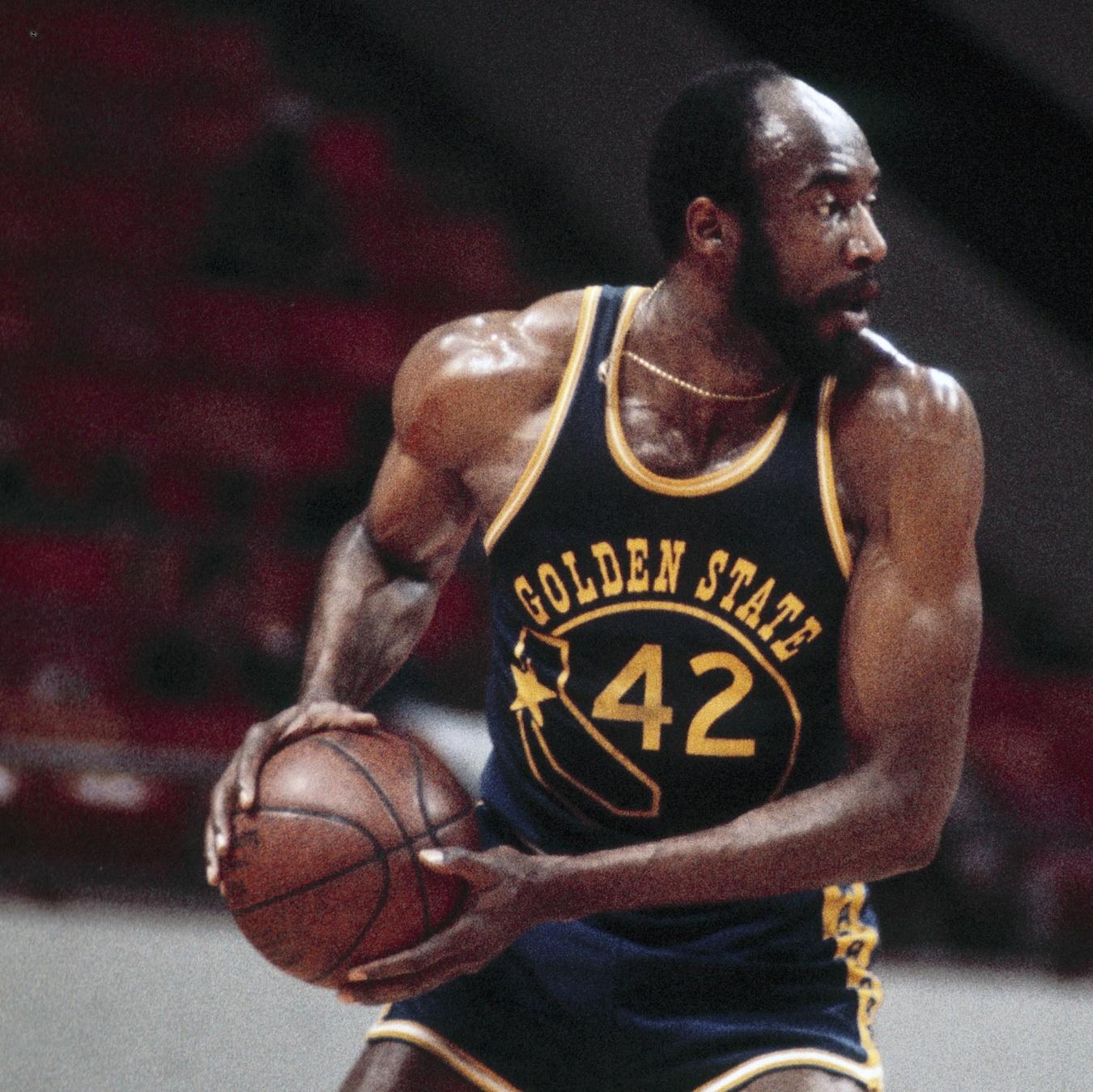
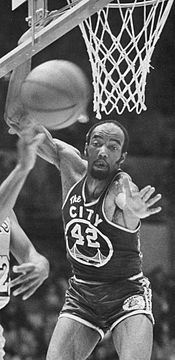
| Nate Thurmond averaged over 20 points per game during five different seasons and over 20 rebounds per game during two seasons while with the Warriors. |
Angered by management's failure to pay him certain incentive bonuses he felt were due him, Barry sat out the 1967–68 season and signed with the Oakland Oaks of the rival American Basketball Association for the following year, but after four seasons in the ABA rejoined the Warriors in 1972. During Barry's absence, the Warriors were no longer title contenders, and the mantle of leadership fell to Thurmond, Jeff Mullins and Rudy LaRusso. They began scheduling more home games in Oakland with the opening of the Oakland Coliseum Arena in 1966 and the 1970–71 season would be the team's last as the San Francisco Warriors.
The franchise adopted its brand name Golden State Warriors prior to the 1971–72 season, in order to suggest that the team represented the entire state of California.[6][b] Almost all home games were played in Oakland that season; six were played in San Diego, but none in San Francisco or Daly City. Oakland Arena became the team's exclusive home court in 1972.
The Warriors made the playoffs from 1971 to 1977 except in 1974, and won
their first NBA championship on the West Coast in
1974–75. In what many consider the biggest upset in NBA history, Golden
State not only defeated the heavily favored
Washington Bullets but humiliated them in a four-game sweep. That team was
coached by former Warrior
Al Attles, and led on the court by Rick Barry and
Jamaal
[14] At 59-23, the Warriors had the league's best record during the
1975–76 season.
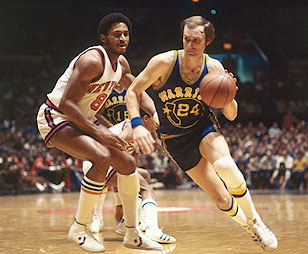
Because of the loss of key players such as Barry, Wilkes and Thurmond to trades and retirements, the Warriors struggled to put a competitive team on the court from 1978 to 1987 after being one of the NBA's dominant teams in the 1960s and most of the 1970s. Through the NBA draft, however, they acquired some players such as high-scoring forward Purvis Short (1978), former Purdue center Joe Barry Carroll (1980) and center Robert Parish (1976), who was traded to the Boston Celtics in 1980 along with the draft pick that would become Kevin McHale for the pick used to draft Carroll. In 1983, the Warriors matched the New York Knicks' offer for free-agent Bernard King, but, unable to pay his high salary, quickly traded him to the Knicks for guard Micheal Ray Richardson, whom they soon shipped to New Jersey in exchange for former Georgetown Hoya point guard Eric "Sleepy" Floyd, and journeyman forward Mickey Johnson. (Floyd once scored 29 points for the Warriors in the fourth quarter of a playoff game against the Lakers, though he was later traded to the Houston Rockets).
The departure of these players for various reasons symbolized the franchise's futility during this period, as head coach Attles moved up to the front office as general manager in 1980 and the team made several coaching changes. New owners Jim Fitzgerald and Dan Finane finally managed to return the team to respectability by hiring former Cleveland Cavaliers head coach George Karl as head coach in 1986 after selecting St. John's small forward Chris Mullin in the 1985 NBA draft.
After a subpar stretch in the late 1970s and early 1980s, the team had a brief resurgence under coach Karl, culminating in a 1987 Western Conference Semifinal match against Magic Johnson and the Los Angeles Lakers which is still shown on TV in the NBA's Greatest Games series. In the game, Warriors' All-Star point guard Sleepy Floyd's performance in the second half still stands as the NBA playoff record for points scored in a quarter (29) and in a half (39). His six consecutive field goals in the fourth quarter led to a 51-point finish for him and a victory for the Warriors.
The "Sleepy Floyd game" was a catalyst for increased interest in the NBA in the Bay Area which was furthered by new coach Don Nelson, who engineered another successful string of wins in the late 1980s and early 1990s with the high-scoring trio of point guard Tim Hardaway, guard Mitch Richmond and forward Chris Mullin (collectively known as "Run TMC" after the rap group Run-D.M.C.). But "Run TMC" stayed together for only two seasons (winning only one playoff series), when coach Nelson, in a move to get a promising young front-court player to complement his run-and-gun system, sent Richmond to the Sacramento Kings for rookie power forward Billy Owens. Nelson had been brought to the Warriors from the Milwaukee Bucks by Jim Fitzgerald, who along with Dan Finnane owned the team between 1986 and 1995. In 1993–94, with first-round draft pick and Rookie of the Year power forward Chris Webber playing alongside off-guard Latrell Sprewell, the Warriors made the playoffs.
At the start of the next season, however, a rift formed between Webber and Sprewell on the one hand and Nelson on the other. All three soon left the team, and the organization went into a tailspin. 1994–95 was the first season under new team owner Chris Cohan, who had bought out Fitzgerald and Finnane. The Warriors selected power forward prospect Joe Smith as their first overall draft pick in 1995 and hired Rick Adelman as the new head coach. They sent Tim Hardaway and Chris Gatling to the Miami Heat for Kevin Willis and Bimbo Coles midway through the 1995–96 season, and ended up with a 36–46 record, three wins short of making the playoffs. While their home court, the Oakland Coliseum Arena, was being extensively renovated, the 1996–97 Warriors played their home games in the San Jose Arena and struggled to a 30–52 finish.[15]
Longtime Seton Hall college coach P. J. Carlesimo, who had been recently fired by the Portland Trail Blazers, replaced Adelman as head coach for 1997–98. Sprewell was suspended for the remainder of the 1997–98 season for losing his temper and choking Carlesimo during a team practice in December, generating the glaring newspaper headline "WARRIORS HIT ROCK BOTTOM" and the declaration by GM Garry St. Jean that Sprewell would never play for the Warriors again. He would not play in the NBA again until he was dealt in January 1999 to the New York Knicks for John Starks, Chris Mills and Terry Cummings.
